


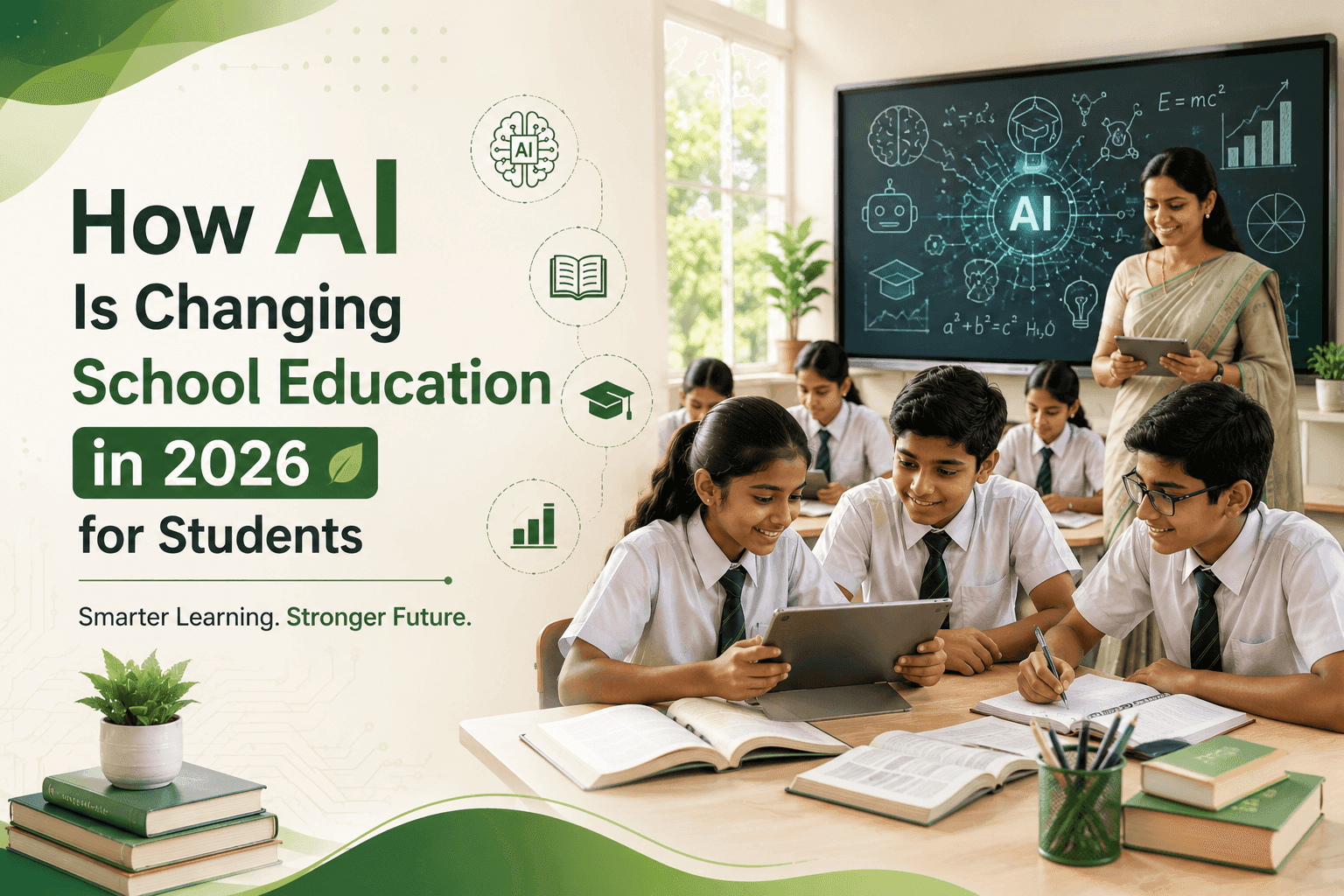
How AI Is Transforming School Education in 2026 for Every Student
June 29, 2026
AI is reshaping school education in 2026 with smart classrooms, personalised learning, digital tools, student benefits, challenges, and how DPS Deoghar prepares learners for the future.
Education in 2026 looks very different from what it did even five years ago. Walk into a modern school today, and you will find students interacting with smart learning apps, solving problems with the help of digital assistants, and receiving instant feedback on their work — all powered by Artificial Intelligence. AI is no longer a concept limited to science fiction or technology companies. It has quietly entered our classrooms and is reshaping how students learn, how teachers teach, and how schools measure progress.
For students in 2026, learning is no longer a one-size-fits-all journey. Instead of every child following the same textbook at the same pace, AI-powered platforms adapt to individual needs, strengths, and learning speeds. This shift is making education more personal, more engaging, and more effective than ever before.
At Delhi Public School, Deoghar, this transformation aligns perfectly with the school's vision of nurturing future-ready learners. As a proud member of the DPS Society, New Delhi, DPS Deoghar is committed to blending academic excellence with modern educational tools — preparing students not just for examinations, but for life in a world shaped by technology.
What Is AI in School Education?
Artificial Intelligence, or AI, refers to computer systems that can perform tasks that typically require human intelligence such as understanding language, recognising patterns, solving problems, and making decisions. In simple terms, AI is technology that learns from data and gets better over time.
In the context of school education, AI appears in many practical and student-friendly forms:
Smart Learning Apps — Applications that track a student's progress and adjust the difficulty of questions based on performance.
AI Chatbots — Digital assistants that answer student questions, explain concepts, and provide study support any time of the day.
Learning Management Platforms — Online systems that organise lessons, assessments, and resources, using AI to suggest what a student should study next.
Digital Assessments — AI-powered tests that evaluate not just right or wrong answers but also how a student thinks and reasons.
In AI in school education 2026, these tools are no longer experimental they are part of everyday classroom life in leading institutions. The goal is not to replace human teaching but to make it more targeted, responsive, and effective for every individual learner.
How AI Helps Students Learn Better
One of the most powerful contributions of AI to education is the ability to personalise learning. Traditional classrooms often struggle to keep pace with both fast learners and those who need more time. AI solves this problem elegantly.
Personalised Learning with AI
AI platforms continuously analyse how a student is performing which topics they understand well, where they are making mistakes, and what type of explanation works best for them. Based on this analysis, the platform creates a personalised learning path. A student who quickly grasps mathematics but needs more time with grammar, for example, will receive a customised experience that supports their exact needs.
Learning at Each Student's Own Pace
In a traditional classroom, lessons move at a fixed pace. With AI tools for students, each learner can progress at a speed that suits them. A student can revisit a concept multiple times without any hesitation or embarrassment. This creates a more confident and stress-free learning experience.
Instant Feedback and Doubt-Solving
Gone are the days of waiting until the next class to get doubts cleared. AI-powered platforms provide instant feedback on assignments and exercises. Students immediately know what they got right, what went wrong, and why — making learning a continuous, self-correcting loop.
Better Practice Through AI Tools
AI generates customised practice problems based on a student's current level, ensuring that practice is always relevant and appropriately challenging. This targeted practice leads to faster mastery of subjects compared to generic homework exercises.
Smart Classrooms in 2026
The classroom of 2026 is a dynamic, technology-enabled environment that goes far beyond chalk and blackboards. Smart classrooms are equipped with tools that make learning visually rich, interactive, and deeply engaging.
Digital Boards and Interactive Lessons
Interactive whiteboards and digital screens allow teachers to present lessons with videos, animations, diagrams, and real-time data. Students can participate directly through tablets or smart devices, making lessons a two-way conversation rather than a one-way lecture.
AI-Based Learning in Schools
AI-based learning in schools means that the technology works in the background, constantly supporting both teachers and students. AI helps teachers identify which students are struggling before they fall too far behind. It suggests interventions, tracks class-wide performance trends, and even flags learning gaps that might otherwise go unnoticed.
Virtual Labs, Simulations, and Visual Learning
One of the most exciting features of smart classrooms is access to virtual labs. Students can conduct science experiments in a risk-free digital environment, explore historical events through immersive simulations, or visualise complex mathematical concepts in three dimensions. This kind of visual and experiential learning creates deeper understanding than reading from a textbook alone.
More Engaging Learning Experiences
When students interact with intelligent content that responds to them — answering their questions, adjusting its difficulty, rewarding progress learning feels less like a chore and more like an adventure. Engagement increases, attention spans improve, and the joy of learning is rediscovered.
You can learn more about DPS Deoghar's technology-forward approach by exploring the school's Robotics and Innovation Lab and Curriculum.
Benefits of AI in Education
The advantages of integrating AI into school education extend well beyond better test scores. Here is a broader picture of what AI brings to the learning journey:
Faster Learning Support
Students no longer have to wait for the next class or the next parent-teacher meeting to get help. AI provides support the moment it is needed, catching learning gaps early and preventing them from becoming bigger problems.
Improved Confidence
When students receive timely, constructive feedback and see their own progress reflected in real-time dashboards, their confidence grows. They begin to believe in their own ability to improve — which is one of the most important foundations of lifelong learning.
Better Exam Preparation
AI can generate personalised mock tests, identify weak areas, and track improvement over time. For students preparing for board examinations and competitive tests, this targeted preparation makes a significant difference. Parents interested in how DPS Deoghar supports academic readiness can visit the Academics section for more information.
More Creative and Critical Thinking
Counterintuitively, AI in education frees students to think more creatively. When routine practice and repetitive drilling is handled by technology, students and teachers have more time for discussion, debate, project-based learning, and creative problem-solving.
Support for Different Learning Styles
Every child learns differently. Some are visual learners, some learn best through listening, and others through doing. AI can detect these preferences and deliver content in the format that works best for each student visual, auditory, or kinesthetic.
AI for Students Learning: Practical Examples
AI in education is not theoretical it is already helping students with real, day-to-day academic challenges. Here are some practical examples of how digital learning for students is taking shape in 2026:
AI Quizzes and Practice Tests — Platforms like adaptive quiz apps create customised question sets based on a student's performance history, ensuring that every quiz is a meaningful learning exercise.
Language Learning Tools — AI-powered language apps help students improve vocabulary, grammar, and reading comprehension through conversational practice and instant correction.
Maths and Science Support — AI tutors can walk students through complex maths problems step by step, explaining each stage in plain language until the concept is fully understood.
Reading and Writing Improvement — AI writing assistants provide feedback on sentence structure, clarity, and grammar, helping students become more confident and expressive writers.
Project Research and Idea Generation — AI tools help students explore topics, find credible sources, organise information, and develop original ideas for projects and assignments — all while being guided to think critically and independently.
These tools complement the rich library resources and academic support systems that schools like DPS Deoghar already have in place.
Future of Education with AI
As AI becomes more deeply integrated into education, a natural question arises: what happens to teachers? The answer is clear — teachers remain absolutely central to education, but their role evolves.
The Role of Teachers with AI
AI handles data-driven tasks: tracking progress, generating practice content, and flagging struggles. Teachers, freed from these time-consuming administrative burdens, can focus on what they do best inspiring students, building relationships, encouraging curiosity, and providing the human empathy that no technology can replicate.
AI as a Learning Assistant, Not a Replacement
AI is best understood as a powerful assistant, not a teacher. It supports the learning process; it does not replace the wisdom, judgement, and mentorship of an experienced educator. The future of education is a collaboration between human teachers and intelligent tools each doing what they do best. DPS Deoghar's teacher training programmes are designed with exactly this future in mind.
More Skill-Based and Personalised Education
The future curriculum will place greater emphasis on skills critical thinking, collaboration, creativity, and communication alongside traditional academic knowledge. AI will support this shift by making space for skill development through personalised learning pathways.
The Importance of Human Values, Discipline, and Creativity
No matter how advanced technology becomes, the core purpose of education remains the same: to build good human beings. Values like honesty, empathy, responsibility, and resilience cannot be taught by an algorithm. Schools like DPS Deoghar, guided by the motto "Service Before Self," understand that technology is a tool in service of character development not the other way around.
AI in Indian Schools
India is witnessing a rapid and inspiring transformation in school education. Across the country — in metro cities and smaller towns alike — schools are embracing digital learning for students and modernising their classrooms.
Growing Use of Digital Learning
The Indian government's initiatives such as DIKSHA (available at pmevidya.education.gov.in) have made digital learning resources accessible to millions of students across different states and languages. CBSE's integration of competency-based learning also reflects a national shift towards skill-focused, technology-supported education. Students and parents can explore CBSE guidelines directly at cbse.gov.in.
How Indian Schools Are Adopting Smart Classrooms
From interactive boards in urban private schools to tablet-based learning in government schools, the AI revolution in Indian education is broad and inclusive. Schools in Tier 2 and Tier 3 cities are rapidly catching up with their metropolitan counterparts in adopting smart learning tools.
Opportunities for Students in Cities and Smaller Towns
One of the most exciting aspects of AI in education is that it reduces the geographical gap in learning quality. A student in Deoghar today can access the same quality of adaptive learning content as a student in Delhi or Mumbai provided they attend a forward-thinking institution.
DPS Deoghar as Part of Modern Learning Growth
Delhi Public School, Deoghar is a proud example of this growth story. Located in Deoghar, Jharkhand, the school brings the legacy and standards of the DPS Society to a region where quality education is making a transformative difference. By offering a curriculum that meets CBSE standards while embracing modern pedagogical tools, DPS Deoghar is ensuring that students in this region have access to a world-class education.
Challenges Students Should Understand
While AI offers tremendous benefits, students must also be aware of its challenges and use it responsibly.
Overdependence on AI
There is a risk that students may begin to rely on AI tools to complete tasks rather than developing their own thinking and problem-solving skills. It is important for students to use AI as a support system, not a shortcut.
The Need for Original Thinking
AI can suggest ideas and provide information, but original creative thinking must come from the student. Developing a unique perspective, forming independent opinions, and producing original work remain irreplaceable human skills that students must nurture.
Safe and Responsible Use of AI
Students must learn to use AI ethically — understanding issues of academic honesty, digital privacy, and the importance of verifying information from reliable sources like NCERT before accepting it as fact.
The Importance of Teacher Guidance
AI tools are most effective when used under the guidance of experienced educators. Teachers help students make sense of what they are learning, correct misconceptions, and connect knowledge to real-life meaning. This human layer of guidance is irreplaceable.
How DPS Deoghar Prepares Students for AI-Based Learning
Delhi Public School, Deoghar is building an educational environment that prepares students not just to use technology, but to thrive in a world shaped by it.
Focus on Technology-Enabled Education
The school's Robotics and Innovation Lab gives students hands-on exposure to modern technology, coding, and problem-solving. This early engagement with technology builds the foundational skills students will need in an AI-driven future.
A Balanced Approach: Academics, Values, Creativity, and Digital Skills
DPS Deoghar does not see technology and values as opposites. The school's approach integrates academic rigour with character development, creative expression through activities, and physical wellness through sports all within a digital-ready learning environment. This balance ensures that students are technically capable, emotionally intelligent, and grounded in strong values.
Modern Infrastructure in Support of Learning
The school's campus and facilities are designed to support contemporary learning styles. From the library to the innovation lab, every space is built to encourage curiosity, collaboration, and creativity.
Preparing Students for Future Careers
In a world where AI is transforming every industry, students who understand and can work alongside intelligent technology will have a significant advantage. DPS Deoghar's curriculum is designed with this future in mind equipping students with the knowledge, skills, and mindset they need to succeed in careers that may not even exist yet.
Parents who wish to know more about the school's approach can explore the Vision and Mission page or visit the About Us section for a deeper understanding of what makes DPS Deoghar different.
Conclusion
AI is changing school education in 2026 in ways that are profound, practical, and full of promise. From personalised learning platforms and smart classrooms to virtual labs and AI-powered doubt-solving, technology is making education more responsive to individual students than ever before. But the most important lesson is this: AI helps students learn smarter, not just faster.
The best version of AI-powered education is one where technology amplifies the power of great teaching — not one where it replaces it. Schools that understand this distinction are the ones shaping truly future-ready learners.
Delhi Public School, Deoghar stands at this intersection of tradition and innovation. Grounded in the values of the DPS Society and committed to a future-ready curriculum, the school offers students in Deoghar and surrounding areas an education that is both deeply human and genuinely modern.
If you would like your child to learn in an environment where curiosity is celebrated, technology is purposefully used, and values are never compromised, we invite you to explore DPS Deoghar further.
👉 Begin your child's journey — Register today 👉 Learn about our Admission Procedure 👉 Contact us for more information
FAQs
AI in school education refers to the use of Artificial Intelligence technology to support and improve the learning experience. This includes smart learning apps that adapt to each student's level, AI chatbots that answer doubts instantly, digital assessment tools, and learning platforms that personalise study plans. In simple terms, AI helps schools teach better and helps students learn smarter.
In 2026, AI has moved from being an experiment to an everyday part of quality schooling. Students now benefit from personalised learning paths, instant feedback on assignments, virtual labs for science and maths, and AI-powered practice tests. Teachers use AI to identify students who are struggling early, so they can provide timely support. The overall result is a more responsive, engaging, and effective education system.
Yes, when used responsibly and under teacher guidance, AI tools are safe for school students. Reputable AI learning platforms are designed with child safety and data privacy in mind. It is important, however, that students are taught to use AI ethically — understanding academic honesty, verifying information from trusted sources like NCERT and CBSE, and not becoming overly dependent on technology for thinking and problem-solving
No. AI will not replace teachers — and it should not. Teachers bring human empathy, mentorship, creativity, and moral guidance that no technology can replicate. In 2026, AI serves as a powerful assistant to teachers, handling routine tasks like tracking progress and generating practice content, so that teachers can focus more time on inspiring and connecting with students. The best education combines the strengths of both.
Some common AI tools used by school students today include adaptive quiz platforms, AI-powered language learning apps, digital maths tutors that explain step-by-step solutions, writing assistants that give grammar and clarity feedback, and research tools that help students explore and organise information for projects. These tools support learning across subjects and are increasingly available in schools across India.
Yes, AI tools can significantly support CBSE exam preparation. AI platforms can generate subject-wise mock tests aligned with the CBSE syllabus, identify weak chapters, track improvement over time, and recommend targeted practice to strengthen specific areas. Combined with the academic support provided by schools like DPS Deoghar, students can approach board exams with greater confidence and preparation.
Get in Touch
Still have questions? Fill out the form below and our team will get back to you shortly.