

How Schools Can Prepare Students for Future Careers Beyond Traditional Learning
Dps Deoghar Team
September 1, 2026
Will your child be ready for jobs that don't exist yet? Discover the skills, methods, and future-ready mindset schools need to build—and how DPS Deoghar is preparing students for careers beyond the classroom.
Every parent has asked the same question at some point: "Will my child be ready for a world that doesn't exist yet?" Careers are changing faster than ever. Jobs that didn't exist ten years ago are now among the most in-demand, and many roles our children will grow into haven't even been invented. This is exactly why marks on a report card no longer tell the full story.
A future-ready school doesn't just teach students to pass exams. It builds the thinking, communication, and problem-solving abilities they will actually need at work. This is where future skills education and strong career preparation come in — helping children build the foundation to thrive, not just survive, in tomorrow's job market.
At DPS Deoghar, this shift in thinking shapes everything from the classroom to the playground. The school combines a strong CBSE academic base with skill-building experiences so students grow into confident, capable adults. In this blog, we'll look at why traditional learning alone isn't enough anymore, what skills truly matter, and how a school environment can prepare children for careers that are still being written.
Why Traditional Learning Is Not Enough for Future Careers
For decades, school success meant memorising facts and scoring well in exams. That approach worked when career paths were predictable and job roles stayed the same for a lifetime. That world doesn't exist anymore.
Here's what has changed:
The job market is shifting constantly. Automation, artificial intelligence, and new industries are reshaping what employers look for. Many in-demand jobs today weren't on anyone's radar a decade ago.
Technology evolves faster than curriculums. A student who only learns facts, without learning how to adapt, struggles to keep pace with new tools and platforms.
Employers want adaptable thinkers, not just knowledge-holders. The ability to learn something new quickly matters more than the ability to recall what was taught in Class 8.
Practical knowledge is now as valuable as theoretical knowledge. Understanding a concept on paper is different from applying it to solve a real problem.
This is why more parents are actively searching for a modern education system that goes beyond textbooks — one that treats skill-building as seriously as syllabus completion.
Essential Skills Students Need for Future Success
So what exactly should a school be building in a child, beyond academic scores? Broadly, four skill areas matter most.
Critical Thinking Skills
Children need to move beyond "what is the answer" to "how do I find the answer." This includes:
Decision-making under uncertainty
Analysing information from multiple sources
Structured problem-solving, not just guesswork
Communication Skills
No career succeeds in isolation. Strong communicators are more likely to lead, collaborate, and be heard. This involves:
Confidence to speak up in a group or interview
Presentation skills to explain ideas clearly
Collaboration skills to work well within a team
Digital & Technology Skills
Almost every career today touches technology in some form. Students benefit from early exposure to:
Basic AI awareness and how it's changing industries
Coding and computational thinking
General digital literacy — using tools responsibly and effectively
Creativity & Innovation
Machines can process data, but original thinking is still a distinctly human skill. Schools should nurture:
Creative thinking in everyday problem-solving
The confidence to propose new ideas
An innovation mindset that isn't afraid of failed attempts
Together, these form the backbone of 21st century skills in education, and they matter far more for long-term career success than rote memorisation ever did.
How Future-Ready Schools Develop Career Skills
Knowing which skills matter is only half the picture. The real question is: how does a school actually build them?
Future-ready institutions rely on a mix of approaches:
Skill-based learning woven into regular subjects, not treated as an "extra" activity
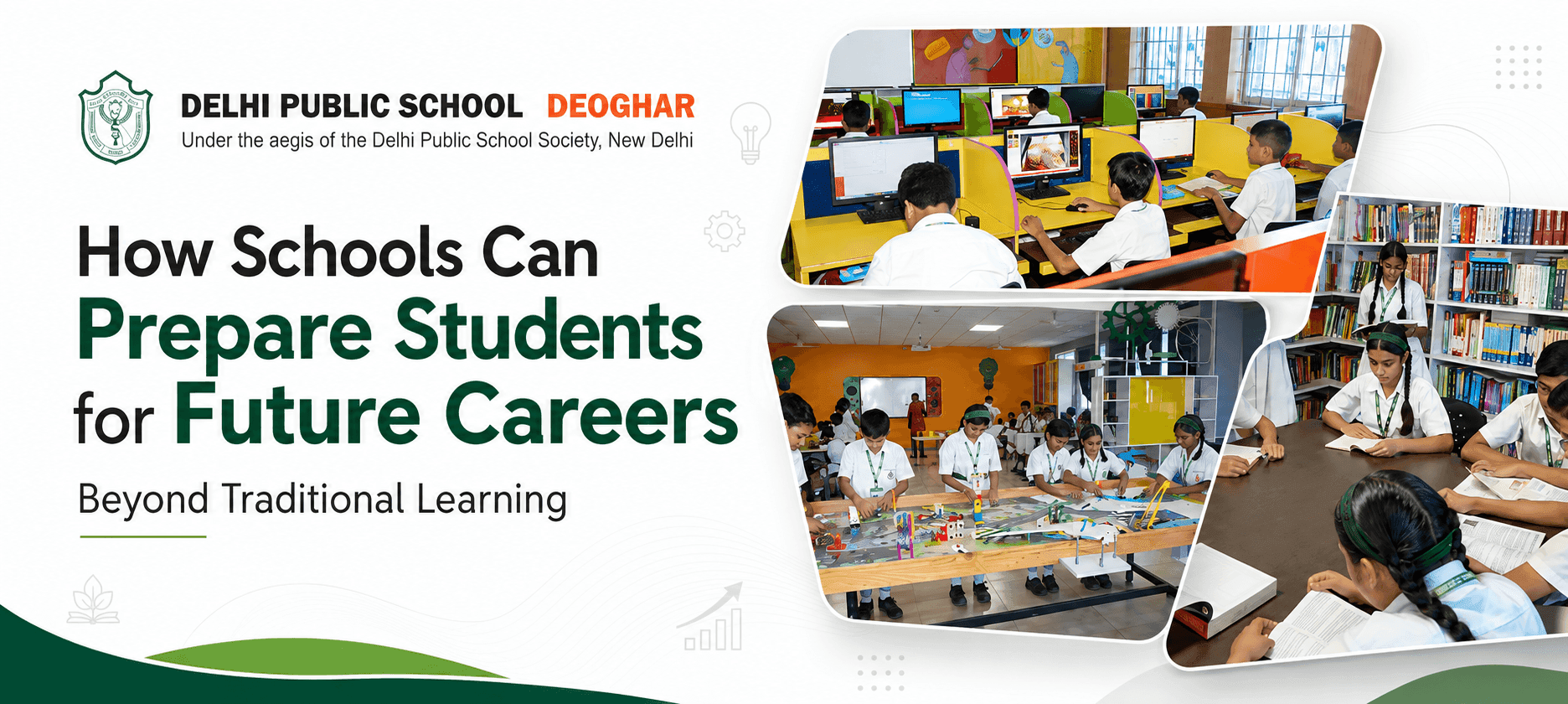
Experiential learning in schools, where students learn by doing rather than only reading
Project-based learning benefits — working on real assignments builds ownership, time management, and teamwork
STEM education, often supported by a dedicated Robotics & Innovation Lab, to strengthen logical and analytical thinking from an early age
Technology integration across classrooms so digital tools feel natural, not intimidating
Leadership opportunities through clubs, student councils, and group responsibilities
Real-world problem solving, connecting classroom concepts to actual situations students may face later
A school that consistently applies these methods gives students a genuine head start, well before they step into a college or a workplace.
Role of Technology in Modern Education
Technology has quietly become one of the biggest differentiators between an average school and a future-ready school.
Smart classrooms make lessons more interactive and easier to grasp, especially for visual and practical learners.
Digital resources give students access to material beyond a single textbook, encouraging independent exploration.
AI-based learning tools can help identify where a student is struggling and personalise support accordingly.
Technology-driven education builds comfort with digital tools that students will use in nearly every future career, regardless of field.
This isn't about screens replacing teachers. It's about technology-based learning in schools working alongside good teaching to make education more relevant to the world students will actually work in.
Importance of Holistic Education for Career Growth
Careers aren't built on academics alone. Some of the most important qualities for long-term success come from outside the classroom.
Academic excellence remains the foundation, but it works best when paired with other skills.
Emotional intelligence helps students manage stress, handle setbacks, and work well with others — a quality employers consistently value.
Sports and extracurricular activities teach discipline, resilience, and teamwork in ways textbooks cannot.
Leadership skills, built through group projects and responsibilities, prepare students to guide others confidently.
Social responsibility, developed through community and service initiatives, shapes well-rounded, empathetic individuals.
This is the essence of holistic education for students — recognising that career readiness is about the whole person, not just their exam scores.
How DPS Deoghar Prepares Students for the Future
DPS Deoghar brings this future-ready approach to life through a thoughtful blend of academics and skill development. You can read more about the school's philosophy and leadership on the About DPS Deoghar page.
The school follows the CBSE curriculum, ensuring students build a strong, recognised academic foundation. Alongside this, DPS Deoghar integrates skill development programs that go beyond the syllabus — encouraging students to think critically, collaborate, and apply what they learn to real situations.
Classrooms are designed around modern teaching methods that keep students engaged rather than passive, supported by well-equipped facilities and infrastructure. Teachers focus on student-centered learning, adapting their approach to how children actually learn best, rather than relying on a one-size-fits-all method.
Beyond academics, the school places genuine emphasis on holistic development — through sports, arts, leadership activities, and community initiatives — helping students grow in confidence and character, not just knowledge.
Final Thoughts
The world our children will work in is being rewritten every year — by new technology, new industries, and new expectations from employers. Preparing them for this future can't be left to textbooks and exam scores alone. It requires a school environment that actively builds critical thinking, communication, digital confidence, and creativity, alongside strong academics.
This is the core idea behind a future-ready school: education that looks beyond the next exam and toward the next twenty years of a child's life. Schools that combine skill development, holistic education, and modern teaching methods give students a genuine advantage — not just in the classroom, but in the careers and challenges that lie ahead.
At DPS Deoghar, this philosophy is reflected in how academics, skill-building, and holistic growth come together every day. For parents in Deoghar weighing their child's long-term education, it's worth exploring how a future-ready education at DPS Deoghar can help set the foundation for a confident, capable future. To learn more or begin the enrolment process, visit the Admission Procedure page or get in touch with the school.
FAQs
Students need critical thinking, strong communication, digital literacy, and creativity to succeed in future careers. These skills help them adapt to changing job roles, work well in teams, and solve real-world problems — qualities that are becoming more valuable than rote memorisation in most industries today.
Skill development in schools helps students apply classroom knowledge practically. It builds confidence, adaptability, and problem-solving ability, preparing them for real work environments. Without it, students may have strong theoretical knowledge but struggle to translate that into practical, real-world performance later in their careers.
Future-ready schools combine academics with experiential learning, project-based assignments, STEM education, and technology integration. They also encourage leadership and real-world problem-solving, ensuring students graduate with both strong subject knowledge and the practical skills employers and higher education institutions increasingly look for.
DPS Deoghar combines the CBSE curriculum with skill development programs, modern teaching methods, and student-centered learning. The school also focuses on holistic development through sports, leadership, and community initiatives, helping students build both academic strength and real-world readiness for future opportunities.
Holistic education develops academics alongside emotional intelligence, leadership, and social responsibility. It ensures students aren't just knowledgeable but also resilient, empathetic, and confident — qualities essential for long-term career and personal success, and ones that pure academic performance alone often fails to build.
Technology improves learning through smart classrooms, digital resources, and AI-based tools that make lessons more interactive and personalised. It also builds digital literacy early, helping students become comfortable with tools they will rely on in nearly every future career and higher education path.
21st century skills include critical thinking, communication, collaboration, creativity, and digital literacy. These go beyond traditional academic knowledge and focus on preparing students to navigate a fast-changing world, adapt to new technologies, and succeed in careers that continue to evolve rapidly.
Schools can improve career readiness by incorporating project-based learning, STEM education, leadership opportunities, and real-world problem-solving into everyday teaching. Pairing strong academics with practical skill-building ensures students leave school genuinely prepared for higher education and the demands of modern careers.
Get in Touch
Still have questions? Fill out the form below and our team will get back to you shortly.