


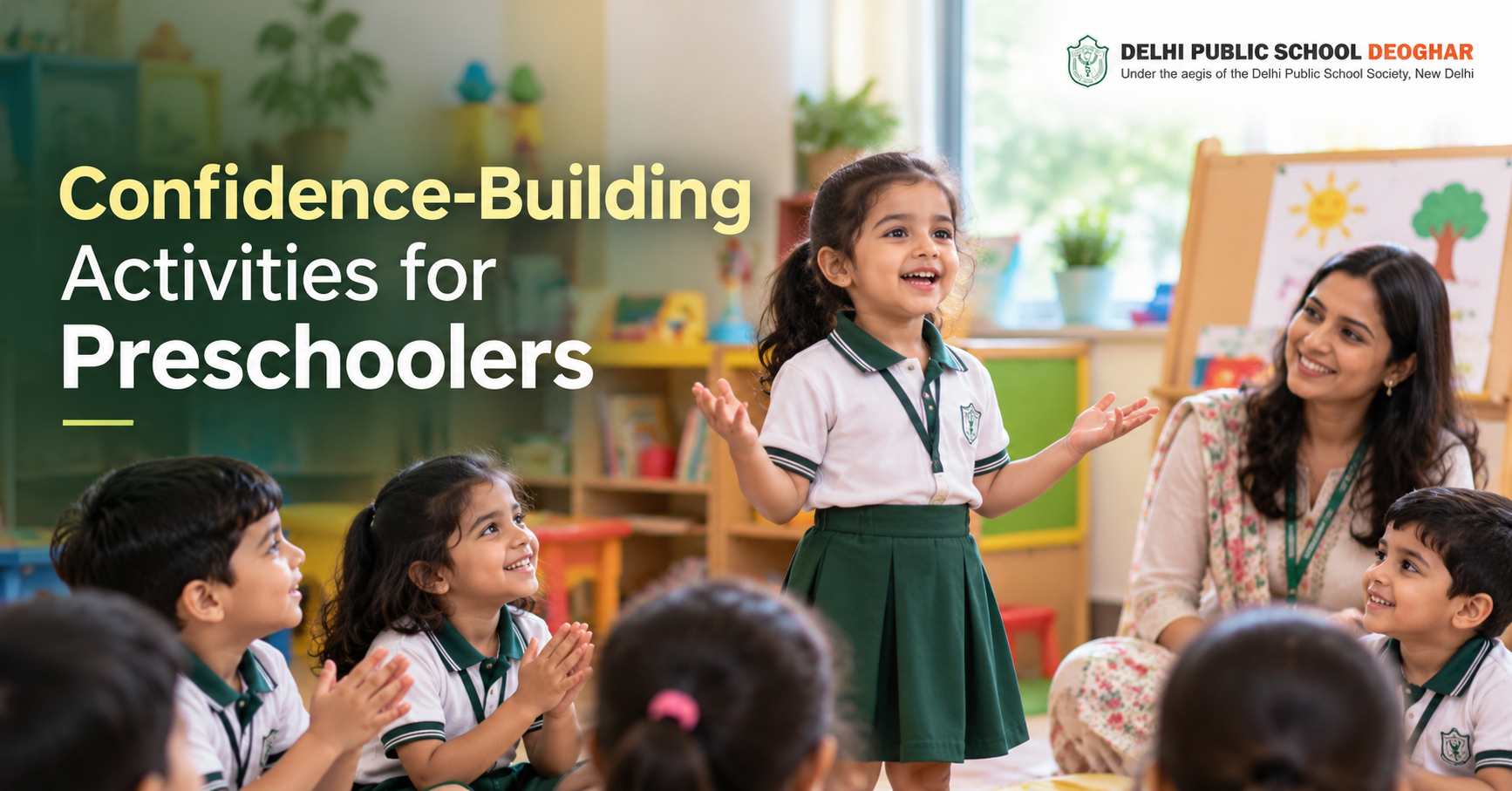
10 Confidence Building Activities for Preschoolers to Try at Home
Dps Deoghar Team
October 23, 2026
Build preschoolers' confidence through pretend play, simple choices, helpful jobs and creative activities. Use small challenges, specific praise and patient support to encourage independence and social skills.
Confidence building activities for preschoolers include pretend play, small household jobs, simple choices, storytelling and cooperative games. Start with manageable tasks, allow mistakes and notice effort so children feel safe trying again.
A child who whispers during introductions may happily lead a game at home. Another may love chatting but hesitate to try a puzzle. Confidence can look different across situations, and being quiet does not automatically mean a child lacks it.
For parents wondering how to build confidence in preschool children, everyday moments offer useful starting points. The activities below suit children aged three to five, with adult support adjusted to each child's comfort and abilities.
Key Takeaways
• Offer achievable challenges and enough time to try.
• Notice specific efforts instead of comparing children.
• Use play, everyday choices and small responsibilities.
• Let hesitant children watch before joining in.
• Coordinate with teachers so encouragement stays consistent.
What Helps Preschoolers Feel Confident?
Confidence grows when children experience belonging, practise skills and discover that mistakes are manageable. Self esteem in young children also involves feeling valued, even when a task goes wrong.
Early childhood confidence development does not require public performances or constant praise. A child asking for help, sharing an idea or returning to an unfinished task is practising useful skills.
UNICEF explains that solving problems through play can give children a sense of competence and accomplishment. Its guidance on play and confidence supports making room for enjoyable, responsive play.
10 Activities to Build Confidence in Kids
Use these self confidence activities for preschoolers as invitations. Begin with something familiar, then add a small challenge when your child seems ready. You don't have to work through the whole list. Pick one your child enjoys.
1. Offer Two Everyday Choices
Ask, "Would you like the blue cup or the green cup?" Offer two options you're happy with. Wait for an answer without steering your child towards your favourite.
Begin with objects they can see. Later, invite them to choose between two books or play activities. Making a manageable decision gives children practice expressing preferences.
Try saying: "You chose the animal book. Let's read it together." Avoid turning simple choices into tests with a correct answer.
2. Give Your Child a Helpful Job
Invite your preschooler to put napkins on the table, sort socks or return picture books to a low shelf. Show one step, then let them attempt it.
Keep it safe. Choose a job your child can manage with a little help. Spills and mismatched socks are opportunities to practise, not reasons to take over immediately.
Say, "You put everyone's napkin out. That helped us get ready." Similar independence building activities for toddlers can start with placing one soft toy in a basket, with close adult supervision.
3. Play Pretend Shop or Preschool
Use empty boxes, toy food or stuffed animals to create a small shop or classroom. Take turns being the customer, teacher or child.
Practise useful phrases such as "Can I have a turn"" and "Please help me.? Let your child change the story or choose a role.
These play based learning activities offer a relaxed way to rehearse unfamiliar interactions. If speaking feels difficult, they can begin by pointing, handing over an object or making a puppet speak.
4. Build Something That Might Fall
Offer large blocks or age-appropriate construction toys. Invite your child to build a bridge, tower or home for an animal.
When it falls, pause before helping. Ask, "What could make the bottom stronger?" If frustration rises, suggest one small change and try together.
Give your child time to figure out what works. The tower doesn't have to be tall. Say, "You tried a wider base." This makes effort and strategy visible without ranking the finished result.
5. Let a Puppet Talk About Feelings
Give a puppet a simple problem: "Rabbit wants to play, but feels nervous about asking." Invite your child to suggest what Rabbit could say.
Model words such as worried, excited, disappointed and proud. Accept gestures or facial expressions as well as spoken answers.
This creates space for emotional development in preschoolers and supports communication skills for preschoolers. Children can explore an uncomfortable feeling through a character without being asked to explain themselves in front of others.
6. Create Art Without a Sample to Copy
Provide paper, washable crayons and age-appropriate craft materials. Ask, "What would you like to make?" Let your child choose the colours. They're also the one who decides when it's finished.
Avoid redrawing their picture or asking why it does not resemble something familiar. Try, "Tell me about these lines."
Creative activities for preschool children give them room to express ideas. Ask permission before displaying the picture, and accept that some children prefer to keep their work private. Explore activities at DPS Deoghar and ask which options are suitable for your child's age.
7. Try One-Person Show-and-Tell
Invite your child to show a favourite object to one trusted adult. They might name it, explain how it works or simply demonstrate.
Offer a starter: "This is my..." Do not insist on a speech. When they feel comfortable, another familiar person could join.
This is one of several confidence building activities for kids who enjoy sharing interests but find groups overwhelming. Keep the audience small and let the child decide whether to continue.
8. Make a Cooperative Treasure Hunt
Hide a few large, safe objects around one room. Give simple clues and search together, with no timer or winner.
Take turns choosing where to look. If a friend joins, give each child a helpful role, such as carrying the basket or checking behind cushions.
Social skills activities for preschoolers can focus on shared success rather than competition. Say, "You listened to each other and found the bear." Change roles so everyone has a chance to contribute.
9. Let Your Child Lead a Movement Game
Ask your child to choose three movements, such as stretching, marching and flapping like a bird. Copy their sequence and invite them to change it.
Keep the space clear and adapt movements for comfort and access. Seated arm movements work too.
Leading a short game offers practice making decisions and being heard. If your child hesitates, lead together first. You don't need an audience or a camera. Just play together.
10. Share an "I Tried" Moment
At bedtime, ask, "What did you try today"" Share your own example first: "I tried a new recipe, and I needed help.?
Your child might mention joining a game, opening a lunch box or asking a question. Drawing the moment is another option.
Avoid requiring a success story every night. Some days, listening is enough. The purpose is to notice learning and persistence, not to make children prove that they have been brave.
How to Encourage Effort Without Pressure
Positive reinforcement for preschoolers works best when children understand what you noticed. The CDC's guidance on specific praise recommends clear, positive words that identify the behaviour.
Try "You waited while I finished speaking" instead of a general "Amazing!" Keep it warm and honest. You don't have to praise every little thing. A smile or quiet acknowledgement may suit a child better than public praise.
Avoid comparisons with siblings and labels such as "the shy one." Offer help without doing every difficult step. If an activity becomes upsetting, reduce the challenge, take a break or choose something else.
Supporting Shy Preschoolers at Their Own Pace
The best activities to boost confidence in shy preschoolers are often familiar, predictable and shared with someone they trust. Start with puppets, parallel drawing or one friend before expecting participation in a larger group.
Explain what will happen beforehand: "We will say hello, then you can choose a toy." Let your child watch first and offer a small role when they are ready.
Your child doesn't have to become outgoing to feel confident. Joining quietly, communicating a need or choosing to try again can all be meaningful progress.
A Simple Routine for Home and Preschool
Choose one brief activity when your child is rested and interested. Five to ten minutes can be a practical starting point, rather than a target every child must meet.
On Monday, offer a choice. On Tuesday, do a helpful job. Later in the week, try pretend play, shared construction or a movement game. Repeat their favourites. You don't need a new idea every day.
Tell the teacher what feels comfortable at home and ask what helps in class. Preschool activities for child development work best when adults respond to the child in front of them, rather than follow a rigid checklist. Reviewing the DPS Deoghar curriculum can help you prepare questions about everyday learning and support.
Choosing a Supportive Preschool in Deoghar
When comparing options for early childhood education in Deoghar, ask how teachers welcome hesitant children, respond to mistakes and encourage independence. Look for opportunities to play, communicate and participate without pressure.
Social emotional learning in preschool should be visible in daily interactions: adults naming feelings, helping children take turns and supporting small conflicts calmly.
Families considering a nursery school in Deoghar can explore DPS Deoghar's approach to holistic development and discuss their child's needs with the school. Review the DPS Deoghar admission procedure for the school's published process before making an enquiry.
Conclusion
The most useful confidence building activities for preschoolers fit into ordinary life: choosing, helping, playing, creating and trying again. Begin with one activity your child enjoys and adjust the challenge gently.
With patient support at home and preschool, children have more opportunities to express themselves, handle small setbacks and discover what they can do. Celebrate those everyday steps at their own pace. To discuss your child's needs, contact DPS Deoghar and ask about support during the preschool transition.
FAQs
Stay nearby and give them time to observe. Offer a small next step, such as rolling a ball to one child. Avoid pushing them into the group or calling attention to their hesitation.
Pretend shops, puppet stories, block building and child-led movement games are useful options. Choose something your child enjoys, offer an achievable challenge and keep the experience playful rather than turning it into a lesson.
Start with one familiar task, such as putting shoes in a basket. Demonstrate it, allow time and help only with the difficult part. Add another responsibility when the first feels manageable.
Acknowledge the difficulty: "That looks tricky." Offer one small first step or ask whether they want help starting. Avoid arguing that it is easy; working together can make trying feel more manageable.
Offer smaller ways to participate, such as showing an object, speaking to the teacher first or sharing with a friend. Discuss these options with the teacher so participation can grow without unnecessary pressure.
Yes. Socks, cardboard boxes, paper, stories and everyday household tasks provide plenty of opportunities. Your attention, patience and willingness to let your child try matter more than having a special activity kit.
There is no fixed timeline. Look for small changes, such as asking for help or trying again after a mistake. Children may feel confident in one setting and hesitant in another; compare progress with their own starting point.
Ask when your child seems comfortable, which activities they choose and what support helps them join in. Agree on one small approach to use at home and school, then share observations without comparing them with classmates.
Get in Touch
Still have questions? Fill out the form below and our team will get back to you shortly.