


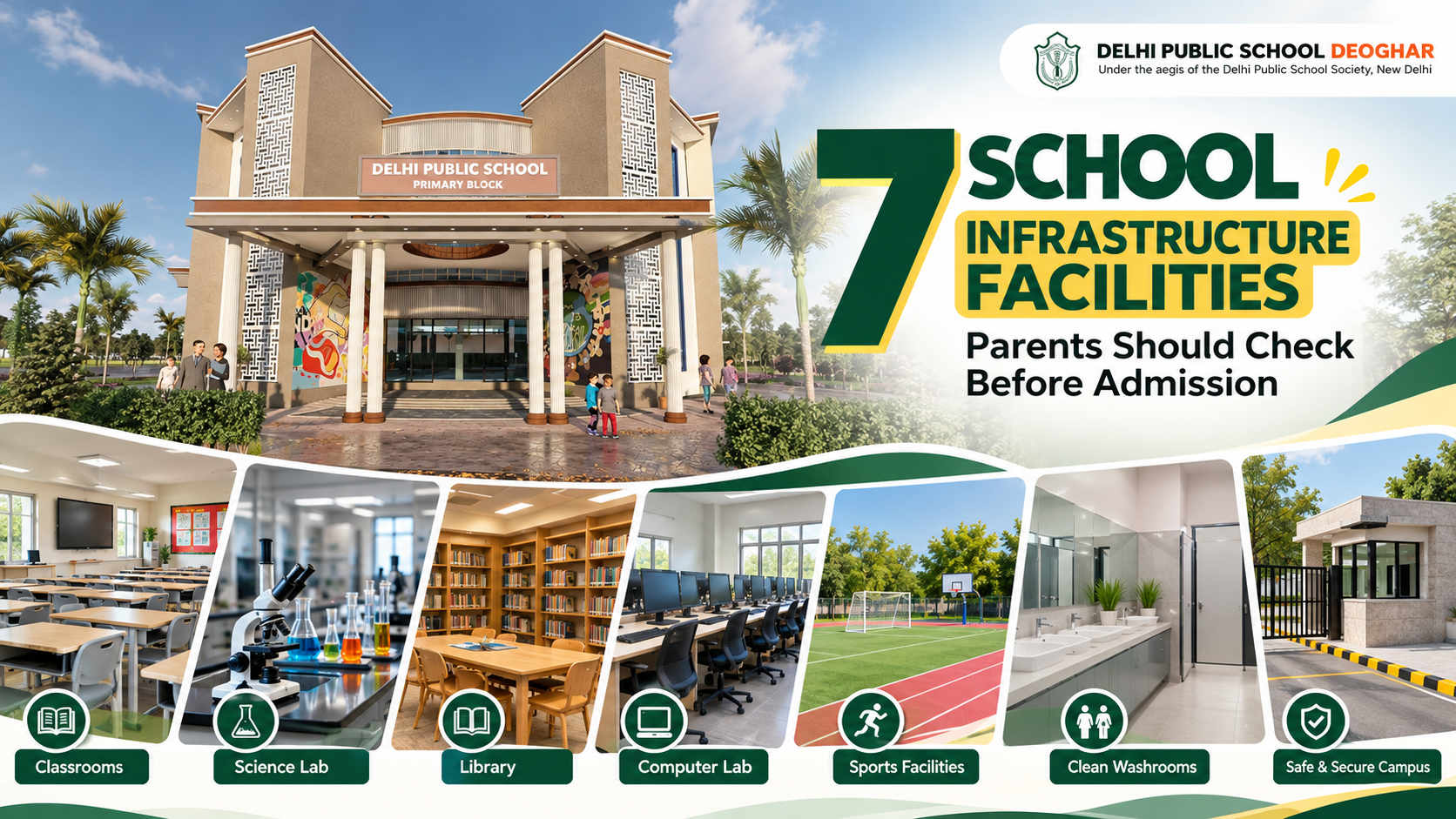
7 School Infrastructure Facilities Parents Should Check Before Admission
Dps Deoghar Team
October 10, 2026
Parents should check seven school facilities before admission: classrooms, science labs, libraries, sports spaces, computers, safety and hygiene, and transport and accessibility. Verify their condition, supervision and regular use.
Key Takeaways
· Check the spaces your child would actually use, with their age, comfort and access needs in mind.
· Ask for timetables and recent activities to understand how regularly learning facilities are used.
· Inspect hygiene and discuss emergency responsibilities alongside visible security equipment.
· Compare schools using the same questions and record the evidence behind each answer.
· Read CBSE provisions with relevant amendments; distinguish official requirements from practical parental advice.
· Confirm published facility descriptions with school staff, especially grade access, transport routes and any services central to your admission decision.
Picture a school visit: you have seen the reception, heard about the curriculum and collected an admission form. Before leaving, take time to examine the school infrastructure facilities your child would actually use.
Parents should check classrooms, science resources, libraries, sports spaces, computer facilities, safety and hygiene arrangements, and transport and accessibility. Evaluate each facility for its condition, suitability for your child’s age, supervision and regular availability. Ask how children use it during an ordinary school week.
Use the visit to connect the prospectus with everyday arrangements. Can your child reach the washroom easily? Which books can they borrow? Who helps if they feel unwell? This guide turns those concerns into practical observations and questions, helping you compare schools on evidence before making an admission decision.
Why Is School Infrastructure Important for Students?
School infrastructure provides the spaces and resources through which children access lessons, reading, practical work and physical activity. Evaluate its importance through safety, comfort, accessibility and participation: can your child use the facilities comfortably, with suitable help and enough opportunities to take part?
India’s Ministry of Education describes a safe school environment as including physical, emotional and other dimensions of safety. Its 2024 explanation of school safety guidance also stresses management accountability.
Learning resources need purposeful use. For example, NCERT’s science activity manual explains how practical activities support observation and understanding. When evaluating school facilities for students, therefore, ask what children do with the resources. Treat modern educational infrastructure as something to investigate through lessons, access and maintenance.
7 Essential School Infrastructure Facilities Parents Should Evaluate
1. Classrooms and Learning Spaces
Classrooms are the spaces for lessons, discussion and individual or group work. Begin with the room your child’s class would use.
Check ventilation, lighting, furniture size and clear walking space. Notice glare, outside noise and whether learning materials are within reach. Ask how seating accommodates children who need additional support. These checks help you judge the student learning environment against your child’s needs.
2. Science Laboratories and Practical Learning Facilities
Science laboratories and activity areas provide space for experiments, observation and handling materials. NCERT’s manual links activity-based science learning with developing observational and analytical skills.
Check which practical resources suit your child’s grade. Ask to see an example activity, equipment storage, safety instructions and supervision arrangements. For school science laboratories, enquire about protective equipment appropriate to the activities undertaken. Do not judge primary learning resources by the appearance of a senior science laboratory.
3. Libraries and Reading Resources
A school library provides books and space for reading and reference work. CBSE’s 2012 reading guidance emphasises children having time to browse and choose books; it is useful educational advice, rather than a statement of current affiliation rules.
Assess school library facilities through age-appropriate books, reading spaces, borrowing arrangements and support for different reading levels. Look beyond the total collection to what your child can access.
4. Sports Grounds and Physical Activity Facilities
Sports facilities in schools include spaces and equipment for physical education, play and organised games. The World Health Organization identifies physical and cognitive development benefits from physical activity in children.
Inspect playing surfaces, equipment condition, boundaries and supervision. Ask about participation for beginners and children needing adaptations, plus arrangements when outdoor sessions cannot run.
For broader context, read the school’s article on sports facilities and school selection.
5. Computer Laboratories and Digital Learning Facilities
Computer labs in schools provide devices for guided digital work. Smart classrooms in schools may also use screens or interactive tools. UNESCO’s 2023 technology report commentary recommends judging technology by educational purpose, evidence and learners’ needs.
Check working devices, student access, teacher supervision and internet safeguards. Request a sample task to understand whether children practise skills themselves. Ask how staff manage screen use and what happens when equipment fails.
Ask staff: “How much practical device time does each child get, and what do they learn?”
6. Safety, Hygiene, and Campus Security
School safety and security covers access control, supervision, emergency response and procedures for reporting concerns. Evaluate these arrangements alongside the physical campus.
Observe visitor checks, staircase protection, clear exits and cleanliness. Ask to see current safety certificates and enquire about evacuation practice, first aid and parent notification. For a hygienic school environment, inspect handwashing points and ask who checks cleaning throughout the day.
The Ministry’s safety guidance addresses both prevention and accountability; use these as discussion points with staff.
7. Transport, Accessibility, and Essential Amenities
This category includes the school journey, movement around campus, drinking water and washrooms. Check usability throughout the day, including for children with disabilities or temporary injuries.
If using school transport, confirm your route, pickup arrangements, supervision and authorised handover. Walk the route from the entrance to classrooms and toilets. Inspect water points, soap availability and suitable washroom access.
School Infrastructure Checklist for Parents Before Admission
Use this checklist to record the essential school facilities to check before admission:
· Visit the classroom allocated to your child’s grade.
· Request a recent practical-learning example.
· Check book selection and borrowing access.
· Review the weekly physical education timetable.
· Ask about children’s access to working computers.
· Inspect washrooms, handwashing and drinking-water points.
· Discuss emergencies, supervision and complaint reporting.
· Check campus accessibility and transport handover.
· Separate facilities currently available from future plans.
Beside each item, write seen, document checked or follow-up needed. Record the date and the staff member who answered. Avoid treating an unanswered question as confirmation.
How to Evaluate School Infrastructure During a Campus Visit
Evaluate school infrastructure and facilities by combining observation, questions and documents. Use the same approach at each shortlisted school:
1. Prepare: Write down your child’s grade, interests, access needs and travel requirements.
2. Observe: Request a visit during an agreed working period without disturbing lessons.
3. Test the detail: Ask for a timetable, activity example or relevant record.
4. Compare: Record evidence immediately after each visit.
5. Follow up: Request written clarification before relying on an important assurance.
Check | Evidence to request |
Regular use | Class timetable |
Learning access | Borrowing or equipment arrangements |
Safety preparation | Valid certificates and drill records |
Child suitability | Grade-specific access and support |
What Should Parents Check in CBSE School Infrastructure in Deoghar?
Parents comparing CBSE school facilities in Deoghar should examine grade suitability, everyday access, travel arrangements and documentary evidence. Use the same checklist across schools, and consider the journey from your own home rather than relying only on a campus address.
CBSE’s published infrastructure provisions cover classrooms, laboratories, libraries, computer facilities, sanitation and accessibility. They distinguish secondary science laboratories from subject-specific senior secondary laboratories. Ask which requirements apply to the school’s affiliation level.
Check the CBSE circular register for amendments before relying on older specifications. Avoid treating every recommendation in this guide as a regulation.
For other selection factors, see this guide to choosing a school in Deoghar.
What Can Parents Learn About DPS Deoghar’s Facilities?
The official DPS Deoghar facilities page describes campus CCTV, staff supervision, bus GPS tracking, drinking-water purification, separate toilets for boys and girls, and a medical room overseen by a qualified nurse.
These are the school’s published descriptions. Ask which arrangements are currently available for your child’s grade and transport route, and request a visit to examine relevant spaces.
Prepare specific follow-up questions about classroom allocation, library access, practical-learning schedules and accessibility. Use the discussion to understand your child’s likely routine and obtain clarification on the facilities most important to your family.
Conclusion
Evaluate school infrastructure facilities through the school day your child would experience. Examine classrooms, practical-learning resources, libraries and activity spaces, then ask about safety, hygiene, supervision and accessibility. Give equal attention to how facilities are maintained and how regularly children can use them.
For DPS Deoghar, begin with its published facility information and prepare questions for a campus visit. Review the official admission procedure and confirm the applicable session details directly with the school. Bring your checklist, discuss your child’s needs and request clarification wherever evidence is incomplete. Make your final comparison using what you have observed, checked and understood.
FAQs
Check classrooms, practical-learning areas, libraries, sports spaces, digital resources, safety arrangements and essential amenities. Assess suitability for your child’s age and needs. During the visit, ask who supervises each area, how often children use it and what arrangements exist when a facility is unavailable.
Infrastructure gives children access to the spaces and resources used for lessons, reading, experiments and physical activity. Consider its value through actual participation. NCERT’s science manual, cited above, explains the role of practical activities in understanding concepts; ask schools how their resources support such activities.
Inspect your child’s likely classroom, washrooms, water points, library, activity spaces and routes between them. Ask permission before entering teaching areas. Pair observations with specific questions about maintenance and supervision, then write down anything that needs clarification before you decide on admission to the school.
Review both visible precautions and staff procedures. Ask about visitor identification, authorised pickup, evacuation practice, first aid and reporting concerns. Request relevant current certificates and discuss who is responsible during an emergency. Use the answers to identify follow-up questions; a brief visit cannot establish complete safety.
Do not make smart classrooms your sole selection criterion. UNESCO’s technology guidance, cited above, favours appropriate, evidence-informed use that serves learners. Ask teachers to demonstrate a lesson and explain the technology’s purpose. Also examine teaching interaction, books, practical activities and access for children who need additional support.
Check facilities against the school’s affiliation level and applicable CBSE provisions. The Board’s infrastructure page covers science laboratories, library resources and physical education spaces, with laboratory distinctions by level. Ask the school to explain applicable requirements and demonstrate access; do not assume every grade needs identical equipment.
Compare schools in Deoghar using one written checklist covering condition, supervision, grade access, maintenance and travel arrangements. Request the same evidence from each school. Keep confirmed information separate from promises, and weigh your child’s daily needs before giving preference to the largest campus or longest facilities list.
Start with the official facilities page, then arrange a visit through the school’s contact page. It explicitly invites visit enquiries. Take questions about your child’s grade, facility access and transport needs, and ask staff to clarify current availability before you rely on a published description.
Get in Touch
Still have questions? Fill out the form below and our team will get back to you shortly.