


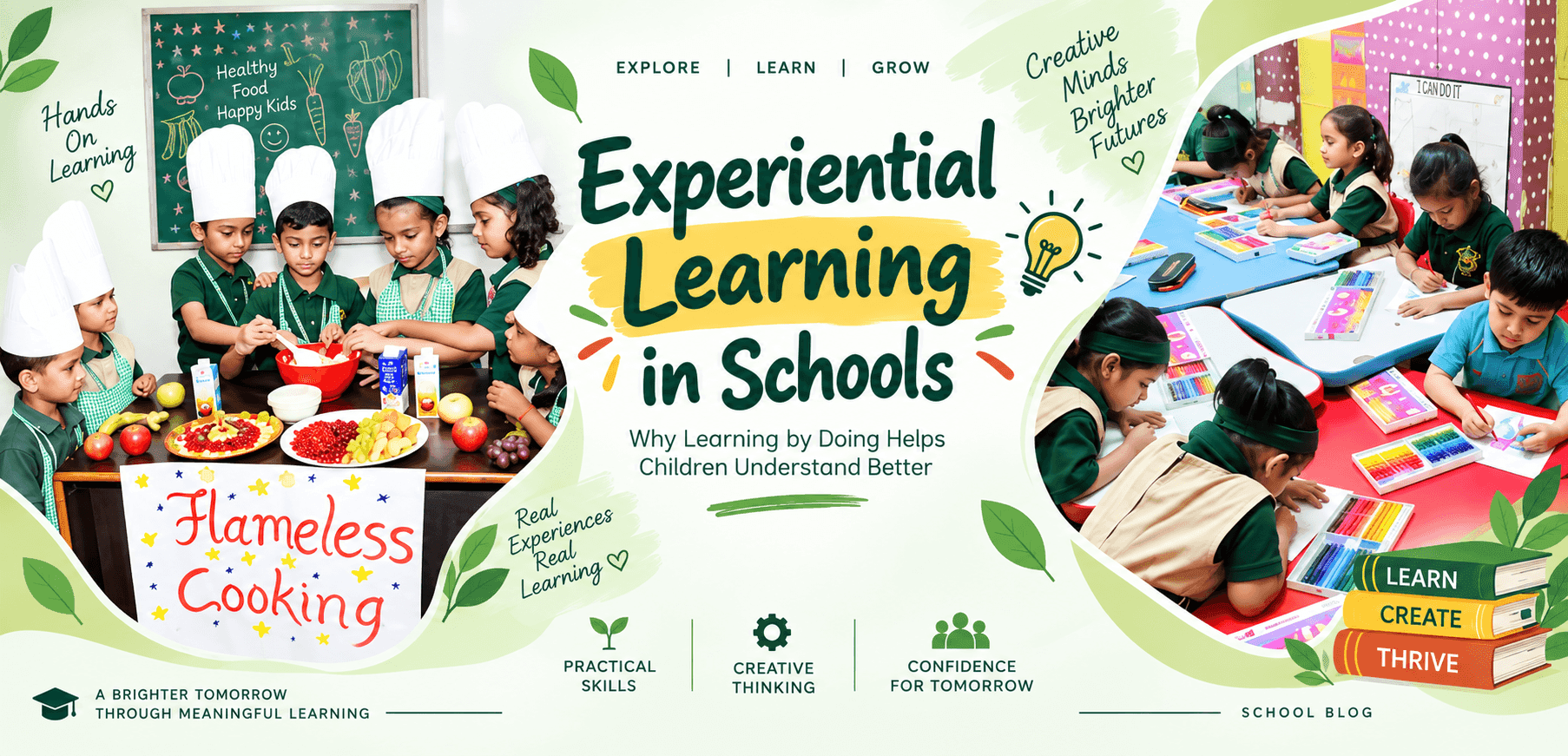
Experiential Learning in Schools: Why Learning by Doing Helps Children Understand Better
September 18, 2026
Ever wondered why your child remembers a science experiment for years but forgets a textbook chapter in weeks? Here's what experiential learning gets right — and how DPS Deoghar brings it into everyday classroom life.
Children often remember a science experiment long after they've forgotten a chapter they read silently at their desks. That difference is at the heart of experiential learning in schools — an approach where students understand concepts by experiencing, exploring, experimenting, and applying them rather than only memorising facts from a textbook. Instead of passively listening to a lecture on plant growth, for instance, a child who plants a seed, waters it daily, and watches it sprout builds a far deeper understanding of the process.
Parents and educators are increasingly drawn to learning by doing because it addresses a common frustration: children can often recite an answer without truly understanding it. Experiential learning bridges that gap by connecting classroom knowledge with real, hands-on experience. This article looks at what experiential learning really means, why it helps children understand better, and how schools, teachers, and parents can support it.
What Is Experiential Learning in Education?
Experiential learning is an educational approach in which students learn through direct experience, reflection, experimentation, and practical application, rather than through memorisation alone.
Rather than simply being told how something works, students are given opportunities to try it themselves. A geography lesson might involve mapping the local neighbourhood instead of only reading about map symbols. A maths lesson might use real coins and shopping scenarios instead of worksheet sums alone. In each case, the learning happens through doing, not just listening.
This approach draws on ideas from active learning and inquiry-based learning, where curiosity and direct involvement guide the process. It also overlaps with student-centred learning, since the child — not the textbook — becomes the starting point for how a topic is explored.Many schools now build this thinking directly into their curriculum design, rather than treating it as an occasional add-on activity.
How Does Learning by Doing Work?
Learning by doing typically follows a natural cycle that moves from action to understanding. Most classroom activities built around experiential learning pass through five broad stages.
Experience. The student is given a task, activity, or problem to engage with directly — building a model, running an experiment, or working on a group project.
Observation. As the activity unfolds, the child notices what happens, what works, and what doesn't. A student mixing colours in an art class observes how blue and yellow combine to make green.
Reflection. The student thinks about what they saw and why it happened. This is often guided by a teacher asking simple questions like "Why do you think that happened?"
Application. The child connects the experience back to the concept being taught — for example, linking the colour-mixing activity to a lesson on primary and secondary colours.
Improvement. With this understanding, the student can try again, refine their approach, or apply the same idea to a new situation, such as predicting what colour two different paints will make.
This cycle of reflective learning is what separates experiential education from simply "doing an activity for fun." The reflection step is what turns an experience into real understanding.
Why Experiential Learning Helps Children Understand Better
Makes Abstract Concepts Easier to Understand
Many school subjects involve ideas that are hard to picture — fractions, chemical reactions, historical events, or economic concepts. When children physically interact with these ideas, such as cutting a fruit into equal parts to understand fractions, the concept becomes concrete rather than abstract. Practical experience gives children something real to anchor the idea to, which makes theory easier to grasp.
Improves Memory and Retention
When a child is actively involved in an activity — moving, touching, building, or experimenting — multiple senses are engaged at once. This kind of active involvement tends to leave a stronger impression than passive listening. A student who has personally conducted a simple volcano experiment is likely to remember the chemical reaction far longer than one who only read about it.
Encourages Curiosity and Questions
Hands-on activities naturally prompt children to ask questions. Why did the ice melt faster in one container than another? What happens if we add more water to the mixture? This kind of exploration encourages curiosity, and curious students are often more engaged learners overall.
Develops Problem-Solving Skills
Experiential learning frequently places children in situations where there isn't a single obvious answer. Building a model bridge that can hold weight, or figuring out how to divide tasks fairly in a group project, requires decision-making, experimentation, and adjustment. Over time, this strengthens problem-solving skills in children in a way that textbook exercises alone rarely do.
Builds Confidence and Independence
Completing a hands-on task — whether it's a science project, a presentation, or a craft activity — gives children a sense of accomplishment. When students solve problems on their own or as part of a team, they begin to trust their own thinking. This steadily builds confidence and independence, both inside and outside the classroom.
Improves Collaboration and Communication
Many experiential activities, from group experiments to classroom debates, require children to work with others. They have to explain their thinking, listen to different viewpoints, and coordinate tasks. This kind of collaborative learning helps children develop communication skills that are just as important as academic knowledge.
Examples of Experiential Learning in Schools
Experiential learning can take many forms depending on the subject and age group. Some common examples include:
Science experiments, where students test hypotheses and observe results firsthand rather than reading about outcomes.
Gardening activities, which help children understand plant biology, patience, and responsibility.
Educational field trips, connecting classroom topics to real-world places such as museums, farms, or historical sites.
Role-playing, useful for subjects like history, language, or social studies, where students act out scenarios to understand perspectives.
Art and craft activities, which build fine motor skills and creative thinking alongside academic concepts.
Coding and robotics, where students apply logical thinking to build and troubleshoot real projects.
School projects, encouraging research, planning, and presentation skills.
Nature exploration, helping children observe ecosystems and natural processes directly.
Mathematics using real-world objects, such as measuring ingredients while cooking or counting change during a mock shop activity.
Group problem-solving tasks, where students work together to design solutions to a given challenge.
Community projects, connecting classroom learning to real social issues, such as organising a small recycling drive.
Presentations and exhibitions, where students showcase what they've learned and practise explaining it to others.
Each of these activities links a specific classroom concept to a practical, real-world experience, which is what makes experiential learning for children so effective.
Experiential Learning vs Traditional Classroom Learning
Traditional classroom learning and experiential learning are not opposing methods — they work best together. Traditional teaching, through lectures, textbooks, and structured lessons, provides students with a solid base of knowledge, vocabulary, and foundational concepts. It is particularly useful for introducing new information in an organised, sequential way.
Experiential learning, on the other hand, gives students the chance to apply that knowledge in practical, real-world learning situations. Practical learning versus traditional learning isn't really a competition; it's a question of balance. A school that only lectures may produce students who can recall facts but struggle to apply them. A school that only relies on activities, without any structured instruction, may leave gaps in foundational knowledge.
The strongest classroom experiential learning environments combine both — clear instruction followed by opportunities to explore, question, and apply what has been taught.
The Role of Teachers in Experiential Learning
In an experiential classroom, teachers take on the role of facilitators, guides, observers, and mentors rather than being the sole source of answers. This shift changes how lessons are planned and delivered.
Effective teachers supporting experiential learning methods typically:
Design meaningful, age-appropriate activities tied to curriculum goals
Ask open-ended questions that encourage thinking rather than one-word answers
Encourage experimentation, even when the outcome isn't guaranteed to be correct
Allow students to make mistakes and learn from them, rather than avoiding failure altogether
Guide reflection after an activity, helping students connect what they did to what they learned
Link activities back to academic concepts, so the experience reinforces the syllabus rather than replacing it
This approach requires more planning and observation than a straightforward lecture, but it allows teachers to see, in real time, how well students are actually understanding a concept.
How Experiential Learning Builds Future-Ready Skills
Beyond academic performance, experiential learning activities help children develop a set of skills that matter well beyond examinations:
Critical thinking — evaluating information and forming reasoned conclusions
Creativity — approaching problems from different angles
Problem-solving — working through challenges methodically
Communication — expressing ideas clearly to different audiences
Collaboration — working effectively within a team
Adaptability — adjusting when a plan doesn't go as expected
Leadership — taking initiative within group settings
Decision-making — weighing options and choosing a course of action
Self-confidence — trusting one's own ability to figure things out
These are the same skills that colleges, workplaces, and everyday life continue to demand long after school exams are over, which is why many schools now treat them as central to a child's holistic development, not just a bonus.
How Parents Can Encourage Learning by Doing at Home
Experiential learning doesn't have to stop at the school gate. Parents can reinforce learning by doing at home with simple, realistic activities:
Cooking together to practise measurements, fractions, and following sequential steps
Gardening to teach children about plant life cycles and patience
Budgeting activities, such as planning a small shopping list within a set amount, to practise mathematics
Simple science experiments using household items, like a baking-soda-and-vinegar reaction
Building models with blocks, kits, or recycled materials to develop spatial reasoning
Reading maps while travelling, helping children connect geography to real journeys
DIY projects, such as fixing a small household item together
Nature walks, encouraging observation of plants, insects, and weather patterns
Educational games that involve strategy, counting, or problem-solving
None of these require special equipment or a lot of time. What matters most is involving the child directly in the task and talking through what they notice along the way.
Why Schools Are Increasingly Adopting Experiential Learning
Education is gradually shifting away from an emphasis on rote memorisation and toward understanding, application, inquiry, and real-world problem-solving. Many schools are redesigning parts of their curriculum to include more project-based learning in schools, lab work, field-based activities, and collaborative tasks, alongside traditional lessons.
This shift reflects a growing recognition that children need to do more than recall information — they need to understand it well enough to use it in new situations. Activity-based learning in schools is one practical way schools are working toward that goal, even as the balance between structured teaching and hands-on exploration continues to evolve.
Final Thoughts
Experiential learning in schools gives children the chance to understand concepts by living through them, not just reading about them.For parents evaluating how a school approaches learning, it's worth exploring how the school structures its own activities programme to see this balance in practice. Whether it's a science experiment, a group project, a nature walk, or a simple cooking activity at home, learning by doing consistently helps children connect classroom knowledge with the world around them.
For parents evaluating how a school approaches learning, it's worth asking how much room is given for hands-on exploration alongside traditional instruction. A thoughtful mix of both tends to produce children who don't just know the answers — they understand why those answers make sense, and they carry that understanding, along with real problem-solving and collaboration skills, well beyond the classroom.
FAQs
Experiential learning in schools is an approach where students gain understanding through direct experience, observation, reflection, and application rather than memorisation alone. It involves activities like experiments, projects, and real-world tasks that let children explore a concept firsthand, connecting classroom teaching with practical, hands-on experience they can relate to.
Experiential learning helps students understand concepts more deeply, retain information for longer, and develop practical skills like problem-solving, communication, and teamwork. It also builds confidence, as children learn to complete tasks and make decisions independently, while encouraging curiosity through open-ended exploration rather than passive listening.
Learning by doing engages children actively rather than passively, helping them connect abstract ideas to real, tangible experiences. When a child performs an activity, observes the outcome, and reflects on why it happened, the concept becomes easier to recall and apply, compared to simply reading or hearing about it.
Common examples include science experiments, gardening, field trips, role-playing, art projects, coding and robotics, group problem-solving tasks, community projects, and using real-world objects for mathematics, such as cooking or budgeting exercises. Each activity links a specific concept to a hands-on, practical experience.
Experiential learning isn't necessarily "better" than traditional learning — the two work best together. Traditional teaching builds foundational knowledge through structured instruction, while experiential learning gives students the chance to apply that knowledge practically. A balanced combination of both tends to support stronger, more complete understanding.
Teachers can incorporate experiential learning by designing hands-on activities tied to lesson goals, asking open-ended questions, encouraging experimentation, and allowing room for mistakes. Guiding students through reflection after an activity — connecting what they did to what they learned — is a key part of making the approach effective.
Get in Touch
Still have questions? Fill out the form below and our team will get back to you shortly.