


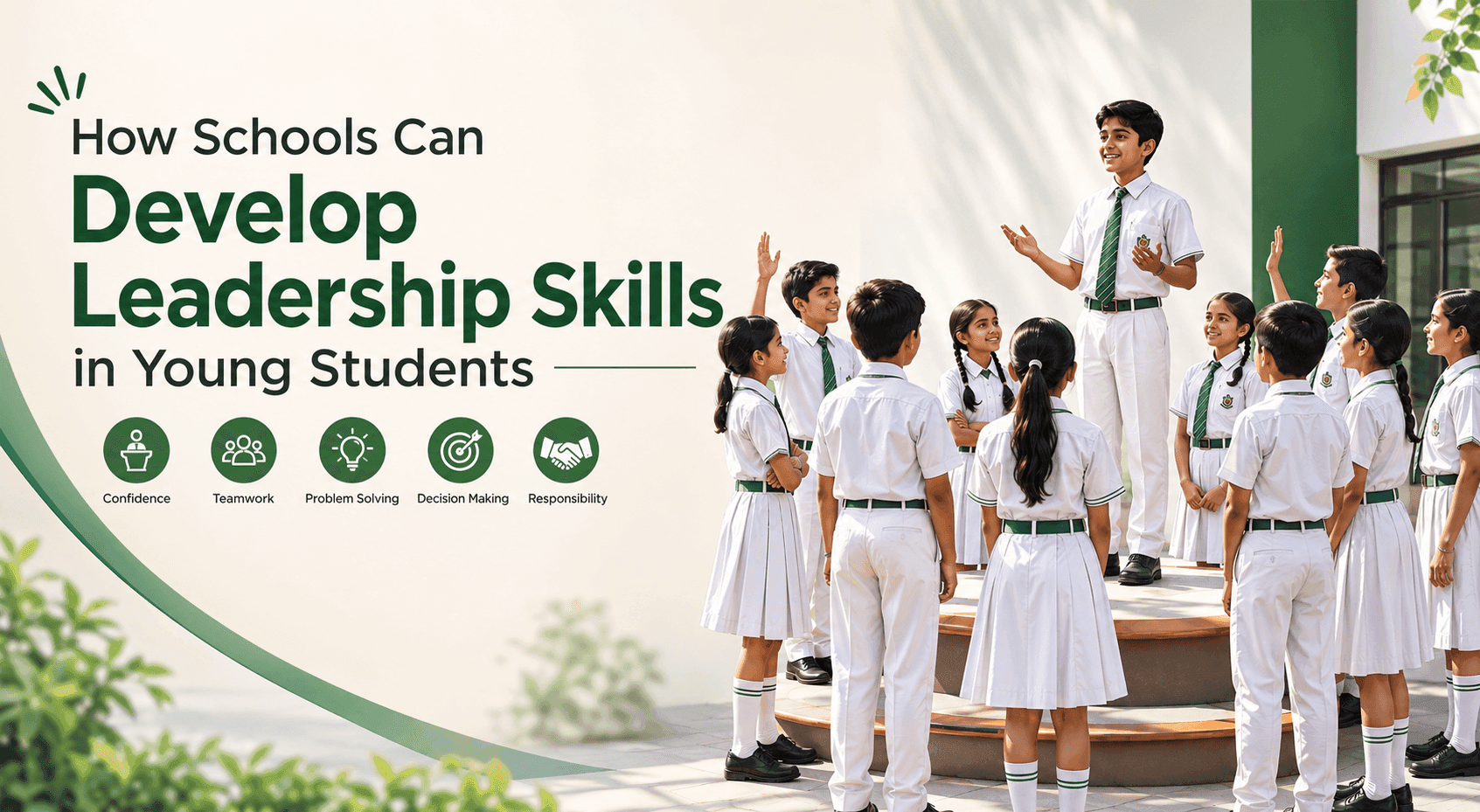
How Schools Can Develop Leadership Skills in Young Students
July 15, 2026
A child who shares a turn, calms a crying classmate, or owns up to a mistake unasked — is already leading. Most parents picture leadership as a stage or a title. Real leadership skills in students start much smaller, and much earlier, than that.
Schools develop leadership skills in students by giving them real responsibilities, chances to work in teams, opportunities to speak up, and situations where they must make decisions and solve problems. Leadership skills in students grow through consistent practice classroom duties, group projects, sports, competitions, clubs, and community activities all play a part.
Top Things to Know
Leadership can be learned from an early age, not just in senior classes.
Responsibility and decision-making build a child's confidence over time.
Team activities develop communication, patience, and cooperation.
Teachers play an important role as mentors who guide rather than direct.
Schools should offer regular opportunities to lead not only formal titles like class monitor or head boy/girl.
Why Leadership Skills Matter for Young Students
Leadership is often misunderstood as something reserved for a few confident, outspoken children. In reality, it is a set of everyday abilities that every student can build confidence, communication, accountability, problem-solving, empathy, teamwork, decision-making, and resilience.
A child who resolves a disagreement between two classmates, supports a struggling teammate, or takes responsibility for a shared task is practising leadership just as much as a student giving a speech on stage. Leadership also teaches students to respect different perspectives, which becomes valuable as they grow into adulthood and work within teams.
Student leadership is not limited to titles or positions. It includes listening carefully, encouraging others, staying accountable for one's role in a group, and making thoughtful choices even in small, everyday classroom moments.
Leadership Qualities Schools Should Encourage
Certain qualities form the foundation of leadership in young learners. Schools that pay attention to these traits help students grow into capable, considerate individuals.
Confidence without arrogance – Believing in one's ideas while remaining open to feedback.
Active listening – Paying genuine attention to others before responding or acting.
Responsibility – Following through on tasks and owning the outcome, good or bad.
Empathy – Understanding and considering how decisions affect others.
Communication – Expressing ideas clearly and respectfully, in speech and writing.
Initiative – Stepping forward to help or solve a problem without being asked.
Decision-making – Weighing options and choosing a reasonable course of action.
Adaptability – Adjusting plans or approaches when circumstances change.
Cooperation – Working well with peers, even those with different working styles.
Integrity – Being honest and fair, particularly when no one is watching.
Practical Ways Schools Can Develop Leadership Skills
Leadership is not taught through a single lesson. It develops gradually, through repeated, practical experiences woven into daily school life.
Assign Meaningful Classroom Responsibilities
Rotating simple duties managing classroom resources, leading a small group activity, organising materials, or presenting a team's work helps students understand accountability. When responsibility shifts regularly, more students get the chance to practise it, rather than the same few being relied upon each time.
Encourage Student Voice and Choice
Teachers can invite students to suggest ideas, choose project topics within a given framework, and participate in small classroom decisions. Asking students to reflect afterwards on what worked well and what they would change builds self-awareness alongside leadership.
Use Group Projects and Collaborative Learning
Structured group work teaches students how to divide tasks, communicate expectations, and resolve minor disagreements. It works best when leadership roles within the group rotate, so no single student always leads and no student is left without the opportunity.
Group projects connected to the school's broader curriculum at DPS Deoghar allow students to apply leadership skills alongside academic learning.
Organise Debates, Speeches and Presentations
Debates, assemblies, storytelling sessions, elocution, and class presentations build confidence, reasoning ability, and respectful communication. Students also learn to listen actively to opposing viewpoints, which is a core leadership skill often overlooked in favour of speaking ability alone.
Build Leadership Through Sports
Team sports teach discipline, cooperation, and the ability to handle both success and disappointment gracefully. Whether it is deciding on-field strategy, encouraging a teammate after a mistake, or accepting a loss with fair play, sport offers some of the most natural leadership lessons available to young students.
Create Clubs and Student-Led Programmes
Literary clubs, environmental groups, art circles, robotics activities, cultural programmes, and house-based activities give students room to plan events, collaborate with peers, and take initiative outside the regular classroom structure. These settings often reveal quieter forms of leadership that may not surface in academic subjects.
Exploring the range of activities at DPS Deoghar gives parents a sense of how such opportunities are structured across age groups.
Use Inter-House and Inter-School Competitions
Competitions help students manage pressure, represent a team rather than themselves alone, support peers during preparation, and learn from both wins and losses. Being part of a competitive team also teaches students to celebrate collective effort rather than individual achievement alone.
The inter-house activities at DPS Deoghar are one example of how schools structure this kind of team-based competition.
Include Community and Environmental Activities
Activities such as tree plantation drives, cleanliness campaigns, awareness programmes, and peer support initiatives build empathy, responsibility, and civic awareness. Students learn that leadership extends beyond the school gates and into the wider community.
Programmes like tree plantation activities in schools show how environmental responsibility and leadership development often go hand in hand.
Teach Problem-Solving Through Real Situations
Practical, age-appropriate problems give students a genuine reason to lead. Examples include:
Planning a small class event or celebration
Managing a defined task within a small team
Solving a real classroom problem, such as organising shared resources fairly
Designing a simple awareness campaign for a school issue
Finding a workable, sustainable solution to a recurring school concern
Encourage Reflection and Constructive Feedback
After any activity, teachers can guide students to reflect on what went well, what felt difficult, and what they would approach differently next time. This habit of reflection turns each experience into a lasting lesson rather than a one-time event.
Role of Teachers in Student Leadership Development
How can teachers encourage student leadership? Teachers encourage leadership by giving every child a genuine chance to participate, recognising quiet as well as visible forms of leadership, asking open-ended questions, allowing age-appropriate decision-making, and treating mistakes as learning opportunities rather than failures.
Beyond this, teachers set the tone for how leadership is understood in a classroom. This includes:
Giving every child a chance to participate, not only the most confident students
Avoiding a consistent preference for outspoken students over quieter ones
Recognising leadership in students who support others rather than direct them
Asking open-ended questions that require students to think through their own answers
Allowing students to make age-appropriate decisions, even small ones
Providing constructive, specific feedback rather than general praise or criticism
Modelling empathy, fairness, responsibility, and respectful communication themselves
Treating mistakes as learning opportunities rather than moments to avoid
At What Age Should Children Learn Leadership Skills?
Children can begin developing leadership skills from early childhood, through simple choices, small responsibilities, sharing, turn-taking, and helping others. Leadership education does not need to wait until secondary school - it grows gradually, becoming more structured as students move through each stage of schooling.
Early years: Simple duties, sharing, turn-taking, and expressing basic ideas
Primary school: Classroom roles, teamwork in small groups, and short presentations
Middle school: Projects, clubs, competitions, and supporting peers
Senior grades: Mentoring younger students, event planning, student councils, and community initiatives
How DPS Deoghar Supports Leadership Development
Delhi Public School, Deoghar approaches leadership development as part of a wider commitment to holistic education, rather than as a separate subject. Its academic and co-curricular structure gives students consistent opportunities to take responsibility, work in teams, and step into different roles as they grow.
Co-curricular activities, inter-house competitions, sports, cultural events, debates, quizzes, and creative programmes each offer students a different way to practise leadership whether through captaining a team, organising a small event, or presenting an idea to an audience. This mix of practical and experiential learning complements classroom teaching and allows students to apply what they learn in real situations.
Parents can get a sense of this holistic learning environment at DPS Deoghar through the school's overall approach to academics and character building. A closer look at the DPS Deoghar campus and activity gallery also offers a glimpse of how these activities come together across the school year.
Practical Tips for Parents
Leadership development does not stop at the school gate. Parents can reinforce it at home in simple, consistent ways:
Give children small, age-appropriate responsibilities at home.
Let them make choices suited to their age, such as planning a small task.
Encourage them to speak respectfully, even when they disagree.
Ask them to attempt solving simple problems independently before stepping in.
Praise effort, honesty, and teamwork rather than only results.
Allow them to experience manageable failure and talk through it afterwards.
Encourage participation in sports, clubs, or group activities they enjoy.
Model responsible and empathetic behaviour in everyday situations.
Helping Every Student Discover the Confidence to Lead
Leadership is not about authority or being the loudest voice in a room. At its core, it is about responsibility, empathy, initiative, cooperation, and the confidence to make positive decisions qualities that develop gradually, through everyday experiences rather than a single moment of recognition.
Schools play a meaningful role in this process by creating consistent opportunities for students to practise these qualities, both inside and outside the classroom. At DPS Deoghar, this happens through a combination of academics, activities, and everyday responsibilities that give every child a chance to grow.
Parents interested in understanding this approach further can explore the DPS Deoghar admission process or contact DPS Deoghar to arrange a school visit and see the learning environment firsthand.
FAQs
Schools develop leadership by giving students real responsibilities, involving them in group work, encouraging them to speak up, and placing them in situations that require decision-making. Regular exposure to teamwork, competitions, clubs, and problem-solving activities — rather than a single lesson — builds these skills gradually over time.
Leadership skills help students build confidence, communication, empathy, and accountability. These abilities support academic performance and personal growth, and prepare students to work well with others, handle responsibility, and make thoughtful decisions both in school and later in life.
Group projects, classroom responsibilities, debates and presentations, team sports, clubs, inter-house competitions, and community service activities all help build leadership. Each activity offers a different way to practise responsibility, teamwork, communication, and decision-making in a practical setting.
Important leadership qualities include confidence without arrogance, active listening, responsibility, empathy, clear communication, initiative, sound decision-making, adaptability, cooperation, and integrity. These qualities develop through practice rather than instruction alone.
Teachers can encourage leadership by giving every student a chance to participate, recognising quiet as well as visible forms of leadership, asking open-ended questions, allowing age-appropriate decisions, and treating mistakes as learning opportunities rather than setbacks.
Children can begin learning leadership skills from early childhood through simple responsibilities, sharing, and turn-taking. As they progress through school, these opportunities become more structured, expanding into teamwork, projects, clubs, and eventually mentoring and event planning in senior grades.
Get in Touch
Still have questions? Fill out the form below and our team will get back to you shortly.