






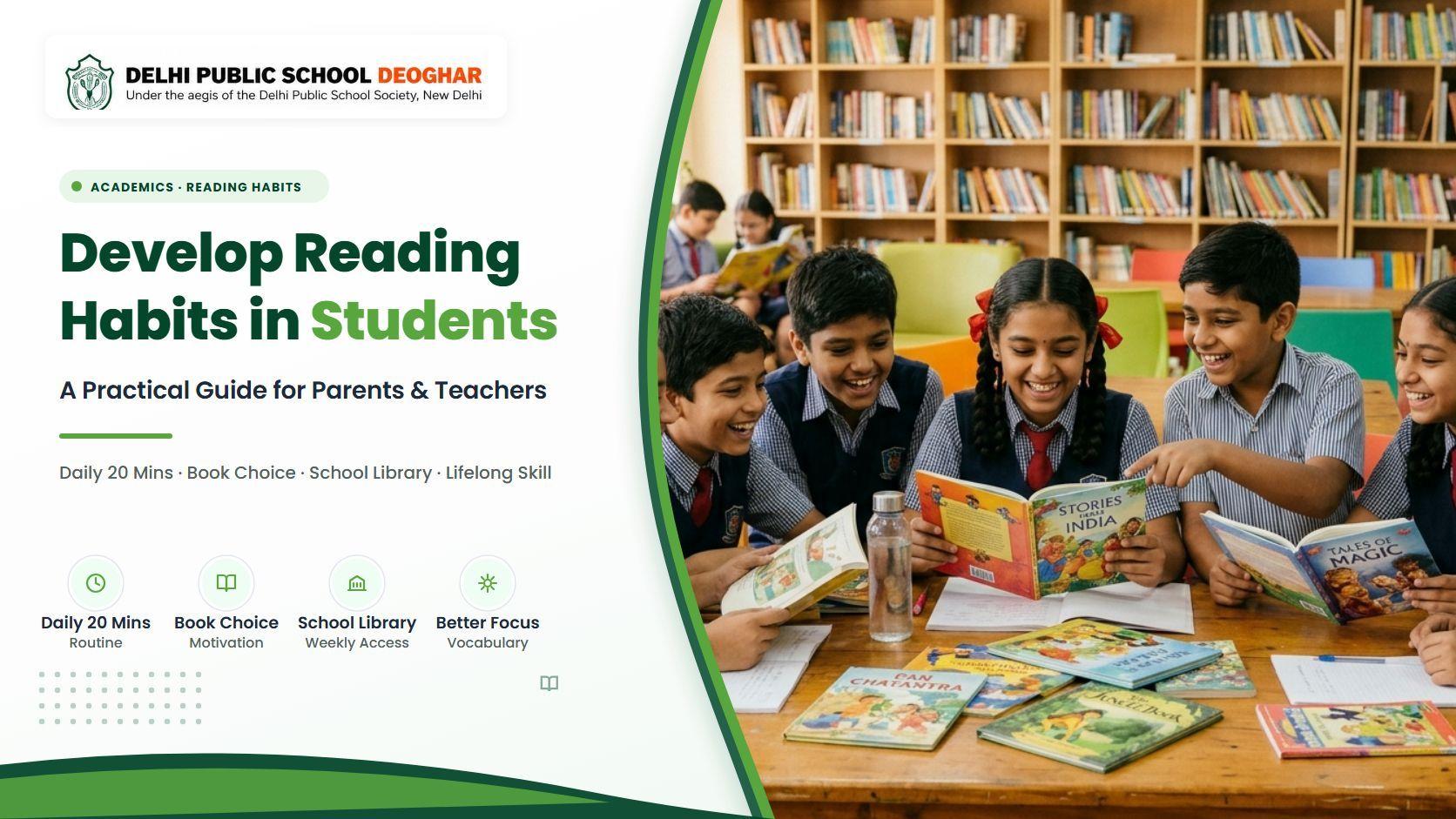
How to Develop Reading Habits in School Students
November 20, 2026
Learn how to develop reading habits in students with simple daily routines, library ideas and parent tips from DPS Deoghar. Build readers for life.
Most parents and teachers have seen it: a child who can read well but picks up a book only when homework demands it. If you are wondering how to develop reading habits in students, the good news is that reading is a skill built through routine, not talent. With the right environment, a little choice and steady encouragement, almost every child can learn to enjoy books.
At Delhi Public School Deoghar, we see reading as the base of every subject. A student who reads regularly understands lessons faster, writes with more confidence and asks better questions. This guide shares practical, classroom-tested ideas that schools and families can start using this week.
Key Takeaways
- Start small and stay consistent: A fixed 15 to 20 minutes of reading every day builds a stronger habit than one long session on weekends.
- Choice drives motivation: Students read more when they pick the book themselves, whether it is a comic, a story or a science magazine.
- Adults set the example: Children copy what they see. When parents and teachers read in front of them, reading feels normal and valuable.
- Environment matters: A reading corner at home and a well-stocked school library make books easy to reach, and easy access leads to regular use.
- Reading lifts results: Regular readers build stronger vocabulary and comprehension, which helps in every subject, not only languages.
Why Are Reading Habits Important for Students?
Reading habits matter because they shape how a child thinks, learns and communicates. A student who reads daily builds vocabulary, concentration and imagination, and these skills support success across all school subjects.
The importance of reading habits goes beyond marks. Reading teaches children to focus for longer periods in a world full of quick distractions. It also builds empathy, because stories let students see life through another person's eyes.
Key Benefits of Reading Books for Students
The benefits of reading books for students are visible both in class and outside it.
- Stronger vocabulary: Every new book exposes students to words they do not hear in daily conversation, and this supports vocabulary development through reading.
- Better reading comprehension skills: Students learn to follow ideas, spot the main point and make inferences.
- Improved writing: Readers absorb sentence structure and style, which shows up in their essays and answers.
- Sharper focus: Sustained reading trains attention, which helps during exams and long study sessions.
- Emotional growth: Stories help children understand feelings, and this builds confidence and kindness.
How to Develop Reading Habits in Students: 7 Practical Steps
The best way to develop reading habits in students is to make reading easy, enjoyable and regular. Fix a daily time, offer choice, create a comfortable space, discuss books and let adults model the habit. The steps below break this down.
1. Fix a Daily Reading Routine
Developing a reading routine is the single most effective step. Choose a time that suits the child, such as right after school snacks or just before bed. Begin with 10 to 15 minutes and slowly move towards 30 minutes. Consistency matters more than duration, so protect this slot as you would protect a meal time.
2. Let Students Choose Their Own Books
When children are forced to read what adults prefer, reading becomes a chore. Let them explore adventure stories, mysteries, biographies, comics or science books. The goal at the start is to build the habit, and the variety can come later.
3. Match Books to the Child's Level
A book that is too hard causes frustration, and one that is too easy gives no growth. A simple check works well: if a student struggles with more than five words on a single page, the book is probably too difficult for now. Good books for school students should feel challenging but enjoyable.
4. Create a Comfortable Reading Space
A quiet corner with good light, a cushion and a small shelf makes reading inviting. Keep phones and televisions away from this space. A visible shelf with books at the child's eye level quietly encourages children to read without any reminders.
5. Read Together and Talk About Books
Shared reading builds closeness and understanding. Younger children enjoy being read to, while older students enjoy discussing plots and characters. Ask open questions such as "What would you have done in this situation?" or "Which character did you like most, and why?" These conversations strengthen comprehension and critical thinking.
6. Use Rewards That Support Reading
Avoid rewarding reading with sweets or screen time. Instead, celebrate with a new book, a visit to the library or a family reading evening. A simple reading chart on the wall lets children see their own progress, and this builds pride and momentum.
7. Balance Screen Time and Reading Time
Digital devices are not the enemy, but unplanned screen use can crowd out books. Set clear screen limits and offer reading as an enjoyable alternative. Audiobooks and e-readers can also help reluctant readers move towards printed books.
How Does Reading Improve Academic Performance?
Reading improves academic performance by strengthening vocabulary, comprehension and concentration. Students who read regularly understand questions better, write clearer answers and learn new concepts faster in subjects like science, social studies and even maths word problems.
Think about a Class 8 science chapter. A student with strong reading skills reads the text once, picks out the key terms and understands the explanation. A weaker reader may need three attempts. Over a full academic year, this difference adds up to hours of saved effort and more confidence during exams.
Strong reading also supports how to improve reading skills in students at a deeper level. Fluency grows with practice, and fluent readers spend their mental energy on understanding ideas instead of decoding words. This is why a school's curriculum works best when reading is woven into every subject, not treated as a separate activity.
How Can Parents Develop Reading Habits in Children?
Parents can develop reading habits in children by reading in front of them, setting a fixed daily slot, visiting libraries together and letting children choose books. Interest and example matter more than pressure or punishment.
Here are simple actions that families can follow:
- Be a reading role model: Keep a book on the sofa and let children see you reading for pleasure.
- Build a home library: Even ten to fifteen books on a shelf can create a reading atmosphere. Swap books with friends or relatives to keep things fresh.
- Make weekend library or bookstore visits a routine: Treat it like an outing, not a task.
- Read aloud at bedtime: This works well for younger children and keeps the bond strong.
- Take an interest: Ask what the child is reading and show real curiosity.
- Avoid comparisons: Every child reads at their own pace, and comparing with siblings or classmates reduces motivation.
How Do Schools Build a Strong Reading Culture?
Schools build a reading culture by giving students easy access to books, protected reading time and exciting reading events. A reading culture in schools grows when teachers, librarians and parents work towards the same goal.
The Importance of School Libraries
The importance of school libraries cannot be overstated. A well-organised library gives every student access to books that they may not be able to buy at home. At DPS Deoghar, the school library is designed to be a welcoming space where students can explore stories, reference books and age-appropriate reading material at their own pace.
Reading Activities for School Students
Structured activities keep reading exciting. Some ideas that work well in classrooms include:
- Silent reading periods: A short, regular slot where everyone, including the teacher, reads.
- Book talks: Students give a two-minute pitch about a book they loved.
- Story-telling and role-play: Children act out scenes to understand characters better.
- Reading challenges: Class-level goals, such as finishing five books in a term.
- Author and poetry sessions: These bring language to life through performance.
Such reading activities for school students work best when they sit alongside other co-curricular activities like drama, debate and creative writing, so that reading connects to real expression.
Sample Daily Reading Habits for Students by Age Group
Daily reading habits for students should match their age and attention span. The list below gives a simple starting point that families and teachers can adjust.
- Classes Nursery to II: 10 to 15 minutes of picture books and read-aloud time, ideally at bedtime.
- Classes III to V: 15 to 20 minutes of storybooks, short chapter books and children's magazines.
- Classes VI to VIII: 20 to 30 minutes of novels, biographies, science articles or newspaper reading.
- Classes IX and above: 30 minutes or more, mixing fiction, non-fiction and subject-related reading.
Conclusion
Learning how to develop reading habits in students does not need expensive tools or complex plans. It needs a fixed routine, freedom to choose books, a welcoming reading space and adults who read themselves. When schools and families work together, children begin to see books as a source of joy and not just homework.
Start with just 15 minutes today. Visit the library this weekend, ask your child about their favourite story and celebrate every small step. If you would like your child to grow in a school that values reading, curiosity and holistic development, explore the admission process at DPS Deoghar or read more helpful parenting and learning guides on our blog.
FAQs
Start with topics your child already enjoys, such as sports, animals, space or cartoons. Offer comics, magazines or audiobooks first. Read together for a few minutes daily without pressure. Interest usually grows once reading feels like fun and not a task.
Younger children can start with 10 to 15 minutes, while older students can aim for 20 to 30 minutes. The exact time matters less than doing it every day. Regular short sessions build a stronger habit than occasional long ones.
The best time is one that fits your family’s routine. Many children read well after school once they have rested, or just before bed when the house is calm. Pick one slot and stay consistent for at least three to four weeks.
Yes. Comics and storybooks are excellent starting points because they are enjoyable and easy to follow. They build reading stamina and vocabulary, and many children move on to longer books naturally once the habit is in place.
Set clear, shared screen limits and keep devices away from the reading corner. Replace some screen time with a reading slot, visit the library together and let your child pick new books. Model the behaviour yourself by reading while they read.
Look for fewer pauses while reading aloud, better answers to questions about the story, new words used in conversation and a longer attention span. Teachers can also share feedback on comprehension and writing during school interactions.
Be patient and choose simpler books at first. Read aloud together, point to words as you go and praise effort. If the struggle continues over several months, speak to the class teacher so the school can guide you on suitable support.
A school library gives free access to a wide variety of age-appropriate books, so children can try different genres without cost. Regular library periods, librarian recommendations and borrowing routines turn reading into a natural part of the school week.
Get in Touch
Still have questions? Fill out the form below and our team will get back to you shortly.