


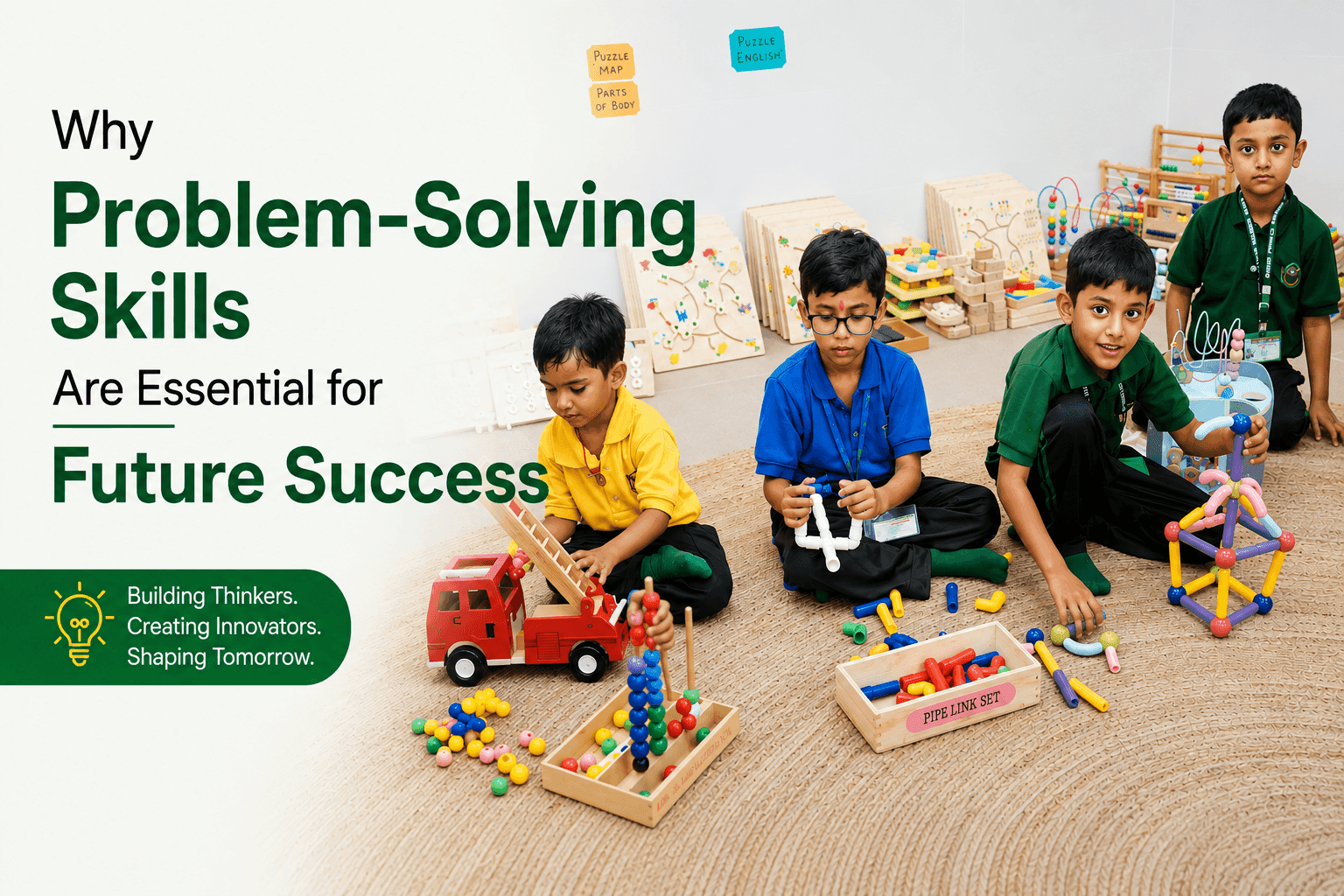
Why Problem-Solving Skills Are Essential for Future Success
Dps Deoghar Team
August 25, 2026
Problem-solving skills help students think independently, make better decisions, and adapt to change — making them essential for future success.
Future success will not be measured only by what students know, but by how well they can analyze situations, weigh options, and respond to problems they have never seen before. Facts can be looked up in seconds. The ability to make sense of those facts and act on them cannot.
This is why problem-solving skills matter so much for students today. They shape how a child handles a difficult math question, a disagreement with a classmate, or an unexpected setback later in a career. Strong problem-solving skills for students build the foundation for confident, independent, and capable adults — which is exactly why they deserve more attention at home and in the classroom.
What Are Problem-Solving Skills?
Problem-solving skills are the abilities a person uses to identify a challenge, understand its cause, and work through it toward a workable solution. They combine logical thinking, creativity, and judgment.
The process typically involves several steps:
Identifying the problem clearly
Understanding what caused it
Analyzing the information available
Exploring possible solutions
Making a decision
Testing the chosen solution
Learning from the outcome
In short: Problem-solving skills are the ability to recognize a challenge, evaluate information and options, choose a reasonable solution, and learn from the result. These skills apply across academics, relationships, and everyday decisions, and they grow stronger with practice over time.
Why Are Problem-Solving Skills Important for Students?
Problem-solving skills matter far beyond test scores and homework. When students regularly practice solving problems, they build habits of mind that carry into every part of life.
Students who develop strong problem-solving abilities tend to think more independently instead of waiting to be told what to do. They also make better decisions because they have practiced weighing options and consequences. Over time, this builds genuine confidence — not the kind that comes from being told they are smart, but the kind that comes from knowing they can figure things out.
Problem-solving skills for students also support:
Adaptability when plans change or new information appears
Resilience after setbacks or mistakes
Logical thinking that connects cause and effect
Creativity in finding more than one way to reach a goal
Comfort with unfamiliar challenges, rather than avoidance of them
These are not abstract traits. They show up the moment a student faces a tricky assignment, an unexpected obstacle, or a decision with no obvious right answer.
7 Benefits of Developing Problem-Solving Skills
1. Builds Critical Thinking Skills
Solving problems requires students to question assumptions, compare options, and reason through evidence before acting. This habit of questioning and evaluating is the core of critical thinking, and it strengthens every time a student works through a genuine challenge rather than following a fixed set of steps.
2. Improves Decision-Making
Every problem involves choices. As students practice weighing the advantages and disadvantages of different paths, they get better at predicting consequences and making informed decisions — a skill that matters as much in daily life as it does in the classroom.
3. Encourages Independent Thinking
Students who are constantly given answers rarely learn to find their own. Problem-solving pushes them to search for solutions on their own first, building the kind of independent thinking that reduces over-reliance on step-by-step instructions.
4. Develops Creativity and Innovation
Most real problems have more than one possible solution. Working through them encourages students to consider multiple approaches, combine ideas in new ways, and think beyond the most obvious answer — the foundation of creative problem-solving.
5. Builds Confidence and Resilience
Struggling with a problem and eventually solving it teaches students that mistakes are part of the process, not a sign of failure. This builds resilience and makes students more willing to try, fail, adjust, and try again — a mindset that serves them well beyond school.
6. Improves Academic Learning
Problem-solving is woven into mathematics, science, research projects, and even language learning. Students who can break down a word problem, design a simple experiment, or structure an essay are applying the same underlying skill: turning a challenge into manageable steps.
7. Prepares Students for Future Careers
Modern workplaces value employees who can analyze a situation, collaborate with others, and make sound decisions without constant supervision. Problem-solving is one of the clearest ways students build these essential skills for future careers well before they enter the workforce.
Problem-Solving Skills and Future Success
Workplaces and industries continue to change due to technology, artificial intelligence, automation, evolving job roles, and global collaboration. Routine tasks are increasingly handled by machines and software.
However, technology mainly provides information and automates repetitive work. It does not replace the need for human judgment, creativity, contextual understanding, communication, and thoughtful decision-making. These remain distinctly human strengths, and they are exactly what strong problem-solving skills for future success are built on.
As roles and tools continue to evolve, future-ready skills for students increasingly center on the ability to adapt, evaluate new situations, and respond effectively — rather than on memorizing a fixed set of procedures. This is why essential skills for future careers so often come back to the same core ability: solving problems that don't yet have a known answer. Developing the skills needed for future success starts with everyday practice, not with predicting exactly what tomorrow's jobs will look like.
How Problem-Solving Develops Other Future-Ready Skills
Problem-solving rarely works in isolation. It connects closely with several other skills that together prepare students for long-term success.
Critical thinking helps evaluate the information a problem presents.
Analytical thinking helps break a complex issue into smaller, manageable parts.
Communication is needed to explain a problem or a proposed solution clearly.
Collaboration comes into play when solutions require teamwork.
Creativity helps generate options beyond the obvious.
Adaptability allows a student to adjust when a first solution doesn't work.
Leadership often emerges naturally when someone takes initiative to solve a shared problem.
Emotional resilience helps students stay calm and persistent when a solution isn't immediate.
Because these skills reinforce one another, strengthening problem-solving ability tends to strengthen this entire network of capabilities at the same time.
Examples of Problem-Solving Skills in Everyday Student Life
Problem-solving shows up far more often than students realize. Common examples include:
Completing a difficult school project with limited time or resources
Resolving a disagreement during group work
Improving a study schedule that isn't working
Working through a challenging math or science problem
Planning a class event within a fixed budget
Managing limited materials for an assignment
Correcting mistakes after receiving feedback from a teacher
Each of these situations follows the same basic pattern: recognize the issue, consider options, choose an approach, and adjust as needed.
How Schools Can Develop Problem-Solving Skills
DPS Deoghar supports the development of these abilities through a well-designed curriculum, though no single method guarantees results on its own. Effective approaches often include:
Inquiry-based learning, where students investigate questions rather than receive direct answers
Project-based learning that requires planning and decision-making over time
Experiential learning through hands-on activities
Collaborative activities that require shared problem-solving
Classroom discussions that explore multiple viewpoints
Puzzles and challenges that build logical reasoning
STEM activities, such as those explored in a dedicated robotics and innovation lab, that combine analysis with practical application
Open-ended questions without a single correct answer
Real-world case studies connected to students' lives
Reflection after mistakes, encouraging students to learn from what didn't work
Used consistently, these methods give students regular practice at working through genuine challenges.
How Parents Can Encourage Problem-Solving at Home
Parents don't need special training to support this skill — small daily habits make a real difference:
Ask open-ended questions instead of yes/no ones
Give children time to think before stepping in
Avoid immediately providing the answer
Involve children in everyday decisions, like planning a meal or a trip
Use age-appropriate games and puzzles
Encourage curiosity by welcoming "why" and "how" questions
Discuss alternative solutions to a problem, not just the first one found
Treat mistakes as learning opportunities rather than failures
These habits send a consistent message: children are capable of working through challenges themselves.
How Students Can Improve Their Problem-Solving Skills
Students can strengthen this ability with a simple, repeatable framework:
Understand the problem clearly before trying to solve it.
Break it into smaller parts to make it easier to manage.
Gather relevant information needed to make a decision.
Think of multiple possible solutions instead of settling on the first idea.
Compare the advantages and disadvantages of each option.
Choose and test the best approach available.
Review the outcome honestly, including what worked and what didn't.
Learn and improve for the next problem faced.
Practicing this framework regularly — even with small, everyday problems — helps make it second nature over time.
Problem-Solving vs Critical Thinking: What Is the Difference?
Critical thinking and problem-solving are closely related but not identical.
Critical thinking is the ability to analyze and evaluate information, question assumptions, and judge whether an argument or idea is sound. Problem-solving takes that analysis a step further by using it to identify a specific issue and implement a workable solution.
In practice, the two frequently work together: critical thinking helps a student understand a situation, while problem-solving helps them act on that understanding.
Why Problem-Solving Matters More Than Memorization Alone
Memorization still has real value. Foundational knowledge — multiplication tables, grammar rules, key historical dates — gives students something to reason with in the first place.
But knowledge alone isn't enough when a situation doesn't match anything memorized before. Problem-solving skills allow students to apply what they know to unfamiliar situations, rather than becoming stuck when a question doesn't follow a familiar pattern. The strongest learners combine both: solid foundational knowledge and the ability to use it flexibly.
Preparing Students for an Uncertain Future
No one can predict exactly which jobs or tools will define the future. At Delhi Public School Deoghar, the focus is on building a student's capacity to adapt, keep learning, think independently, and make responsible decisions when facing something new.
That is the real value of problem-solving skills — not a guarantee of any specific outcome, but a foundation of confidence and capability that holds up regardless of what changes around it.
Conclusion
Problem-solving skills give students far more than a way to finish an assignment. They build the ability to think independently, make thoughtful decisions, and adapt when circumstances change. Students who practice solving real problems learn from mistakes instead of fearing them, and they grow more confident applying what they know to new situations.
As classrooms, careers, and daily life continue to evolve, problem-solving skills remain one of the most dependable foundations for future success — supporting students not just through school, but through every unfamiliar challenge that comes after it.
FAQs
Problem-solving skills for students are the abilities used to identify a challenge, analyze relevant information, consider possible solutions, and choose a reasonable course of action. They apply to academic work, social situations, and everyday decisions, and they develop through regular, guided practice.
Problem-solving skills are important for future success because they help students handle unfamiliar situations that memorized facts alone can't address. As workplaces and technology continue to change, the ability to analyze, adapt, and make sound decisions remains consistently valuable.
Students can improve by practicing a clear framework: understanding the problem, breaking it into parts, gathering information, considering multiple solutions, choosing an approach, testing it, and reviewing the outcome. Regular practice with small, everyday problems builds this ability over time.
Problem-solving requires students to question assumptions, compare information, and evaluate options before choosing a solution. This repeated practice of analyzing and reasoning strengthens critical thinking, since the two skills naturally reinforce one another.
Employers value problem-solving skills because modern workplaces require employees who can analyze situations, collaborate with others, and make sound decisions independently. As routine tasks become automated, judgment and adaptability become more important than following fixed procedures.
Parents can help by asking open-ended questions, giving children time to think before offering answers, involving them in everyday decisions, and treating mistakes as learning opportunities. Simple habits like these build confidence and independent thinking over time.
Get in Touch
Still have questions? Fill out the form below and our team will get back to you shortly.