


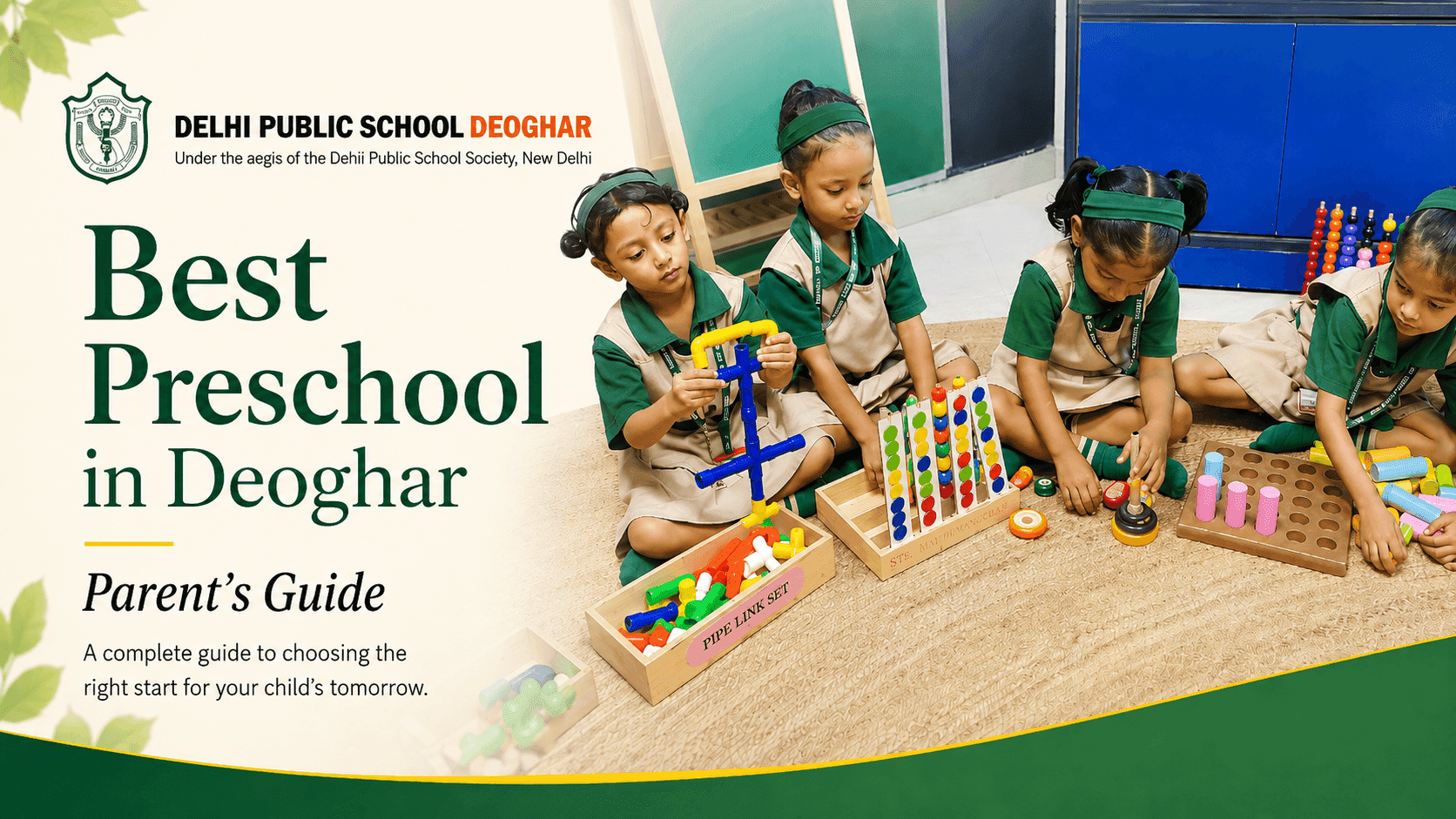
How to Choose the Best Preschool in Deoghar for Your Child
August 18, 2026
Finding the best preschool in Deoghar starts with knowing what truly matters. Compare curriculum, teachers, safety, learning environment and school readiness to find the right fit for your child.
Choosing a preschool is often a child's first step into structured learning, and it's natural for parents to feel unsure where to start. Finding the best preschool in Deoghar means looking beyond distance from home, fees, or how polished a building looks. What actually shapes a child's early experience is the learning philosophy, teacher quality, safety and hygiene, opportunities for play, how the school communicates with families, and whether the child feels genuinely comfortable. This guide walks through each of these factors so parents can evaluate any preschool in Deoghar with confidence.
How do you choose the best preschool in Deoghar?
Compare the curriculum's age-appropriateness, the balance of play-based learning with structured activity, teacher quality and child-teacher interaction, safety and hygiene practices, the learning environment, support for social-emotional development, and how openly the school communicates with parents. Ultimately, school readiness and the child's own comfort and enthusiasm should guide the final decision.
Why Choosing the Right Preschool Matters
The early years, roughly ages three to six, are when children build the foundations for language, social behaviour, and lifelong learning habits. A good preschool experience supports:
Language development through conversation and storytelling
Curiosity, encouraged by hands-on exploration
Social behaviour, including sharing and cooperative play
Confidence, built through small achievable challenges
Emotional regulation and independence
No single preschool determines a child's entire future. A strong Early Years programme simply creates a positive, low-pressure foundation for later learning — the goal is comfort and curiosity, not academic acceleration.
10 Things Parents Should Look for When Choosing a Preschool in Deoghar
1. Start With the Preschool's Learning Philosophy
Understand how a school actually teaches. Quality Early Years programmes lean on play based learning, activity-based learning, Montessori preschool in Deoghar-style practices, and experiential learning, rather than worksheets. Worksheets have a place, but shouldn't dominate — young children grasp concepts like counting or cause-and-effect faster through hands-on activity. Ask any school: "What does a normal day look like, hour by hour?" The answer reveals whether play and structure are truly balanced.
2. Check Whether the Curriculum Is Age-Appropriate
A good curriculum balances language, early numeracy, fine and gross motor skills, art, music, storytelling, exploration, social interaction, and life skills. There's a real difference between preparing children for learning and pushing academics too early — readiness skills like listening and cooperating matter more long-term than early reading drills. Many Indian preschools now design curricula referencing Early Childhood Care and Education (ECCE) guidelines and NEP 2020, both of which favour play-based, developmentally appropriate learning for under-sixes. It's reasonable to ask any school whether their curriculum reflects these frameworks.
3. Understand the Different Preschool Stages
Stage | Typical Age | Main Development Focus |
|---|---|---|
Pre-Nursery | 3–4 years | Routine, communication, sensory play, independence |
Nursery | 4–5 years | Language, numeracy foundations, creativity, social development |
Preparatory | 5–6 years | School readiness, confidence, early literacy and numeracy |
A preschool for 3 year old in Deoghar typically means Pre-Nursery; a nursery school for 4 year old in Deoghar fits the Nursery stage; a preparatory school in Deoghar for five- to six-year-olds focuses on readiness for primary school. Age criteria vary by school, so always verify current requirements directly.
4. Observe the Teachers, Not Just the Classroom
A decorated classroom can be misleading — what matters daily is how teachers interact with children. Look for warm, patient interaction; child-friendly language; responsiveness to different temperaments; and encouragement rather than pressure. A preschool with good teachers in Deoghar usually shows these qualities within minutes — teachers who kneel to a child's eye level and redirect rather than scold.
5. Evaluate Safety, Hygiene and Child Supervision
During a visit, check entry/exit and pick-up authorisation, classroom supervision, washroom hygiene, drinking water, play-area safety, emergency preparedness, and age-appropriate furniture. Safety practices vary between institutions, so don't rely on assumptions about any particular safe preschool in Deoghar — ask directly and observe for yourself.
6. Look for a Child-Friendly Learning Environment
A child friendly preschool in Deoghar should feel welcoming without being overstimulating: bright, cheerful spaces; materials placed at a child's height; distinct activity areas for reading, art, and building; and outdoor or physical activity opportunities where campus space allows. Environments that let children make small choices tend to build independence more effectively than rigid, uniform setups.
7. Check How the School Supports Social and Emotional Development
Look at how the school helps children with sharing, taking turns, making friends, expressing feelings, and managing separation anxiety. These skills often matter as much as early literacy and numeracy in determining how comfortably a child adapts to school.
8. Ask How Parents and Teachers Communicate
Preschool works best as a partnership between school and family. Useful questions to ask:
How often will I get updates about my child's day?
What format do parent-teacher meetings take, and how often?
If my child has a difficult week, how would I find out?
Can I occasionally observe the classroom?
9. Consider School Readiness, Not Just Academic Readiness
School readiness includes following routines, listening, communicating needs, working independently for short periods, participating in groups, emotional confidence, and basic literacy/numeracy exposure. This matters most when comparing Nursery and Preparatory programmes — Preparatory-stage children are generally expected to show stronger independence, while Nursery-stage children are still building social-emotional groundwork.
10. Visit the Preschool Before Making the Final Decision
No website — including this one — substitutes for an in-person visit. Watch whether children seem comfortable, whether teachers actively engage rather than just supervise, and whether learning is visible through activities rather than worksheets. Notice how staff handle separation anxiety and whether parents are clearly briefed on routines. In the end, your child's comfort and engagement during the visit should weigh most heavily.
Questions to Ask During a Preschool Visit
What teaching approach does the preschool follow?
What does a typical day look like?
How much time is given to play and physical activity?
How is separation anxiety supported in early weeks?
How does the school communicate progress to parents?
What are the safety and pick-up procedures?
What Early Years training do teachers have?
How does the school prepare children for the next stage?
What activities support language, creativity and social development?
What is the admission process and age criterion?
Preschool Red Flags Parents Should Not Ignore
Heavy reliance on worksheets with little play
Very limited physical activity or outdoor time
Teachers who frequently shout at children
Unclear or inconsistent safety procedures
Little transparent communication with parents
Children who appear unusually disengaged
Rigid academic pressure inappropriate for age
No clear daily routine
Visible gaps in cleanliness or supervision
None of these alone is disqualifying, but a pattern of several is worth a closer look.
How DPS Deoghar Approaches the Early Years
DPS Deoghar's Early Years programme is designed for children roughly aged three to six, structured across three stages: Pre-Nursery (3–4 years), Nursery (4–5 years), and Preparatory (5–6 years). Each stage targets age-appropriate goals — sensory play, routine, and communication in Pre-Nursery; language and numeracy foundations in Nursery; school readiness and early literacy in Preparatory.
The DPS Deoghar Early Years programme is described as combining Montessori principles, Early Childhood Care and Education practices, and NEP 2020–aligned thinking, aimed at holistic development — curiosity, creativity, confidence, and social-emotional growth alongside age-appropriate academic exposure — to help prepare children for primary school.
As with any school, the most useful next step is to evaluate the Early Years programme at DPS Deoghar against the checklist above — its philosophy, teacher interaction, safety practices, and communication style — ideally through a direct campus visit rather than relying on descriptions alone.
Final Preschool Selection Checklist for Parents
Age-appropriate curriculum
Play-based learning built into the daily routine
Qualified and caring teachers
Safe, well-supervised environment
Clean classrooms and facilities
Positive teacher-child interaction
Support for social-emotional learning
Adequate physical activity
Clear, regular parent-school communication
Genuine attention to school readiness
Child feels comfortable and enthusiastic
Convenient location and practical routine
Conclusion
There's no single factor that determines the best preschool in Deoghar for every family — the right choice depends on your child's temperament and what you observe firsthand. Rather than focusing on one feature, look at the whole picture: a strong learning philosophy, warm teachers, genuine safety practices, an engaging environment, and open school-parent communication. Together, these create real school readiness.
Visiting the school and watching how your child responds will tell you more than any brochure. If you'd like to explore how DPS Deoghar approaches these areas in practice, you're welcome to look into the Early Years programme or contact the school directly to arrange a campus visit and learn more about admissions.
Get in Touch
Still have questions? Fill out the form below and our team will get back to you shortly.