


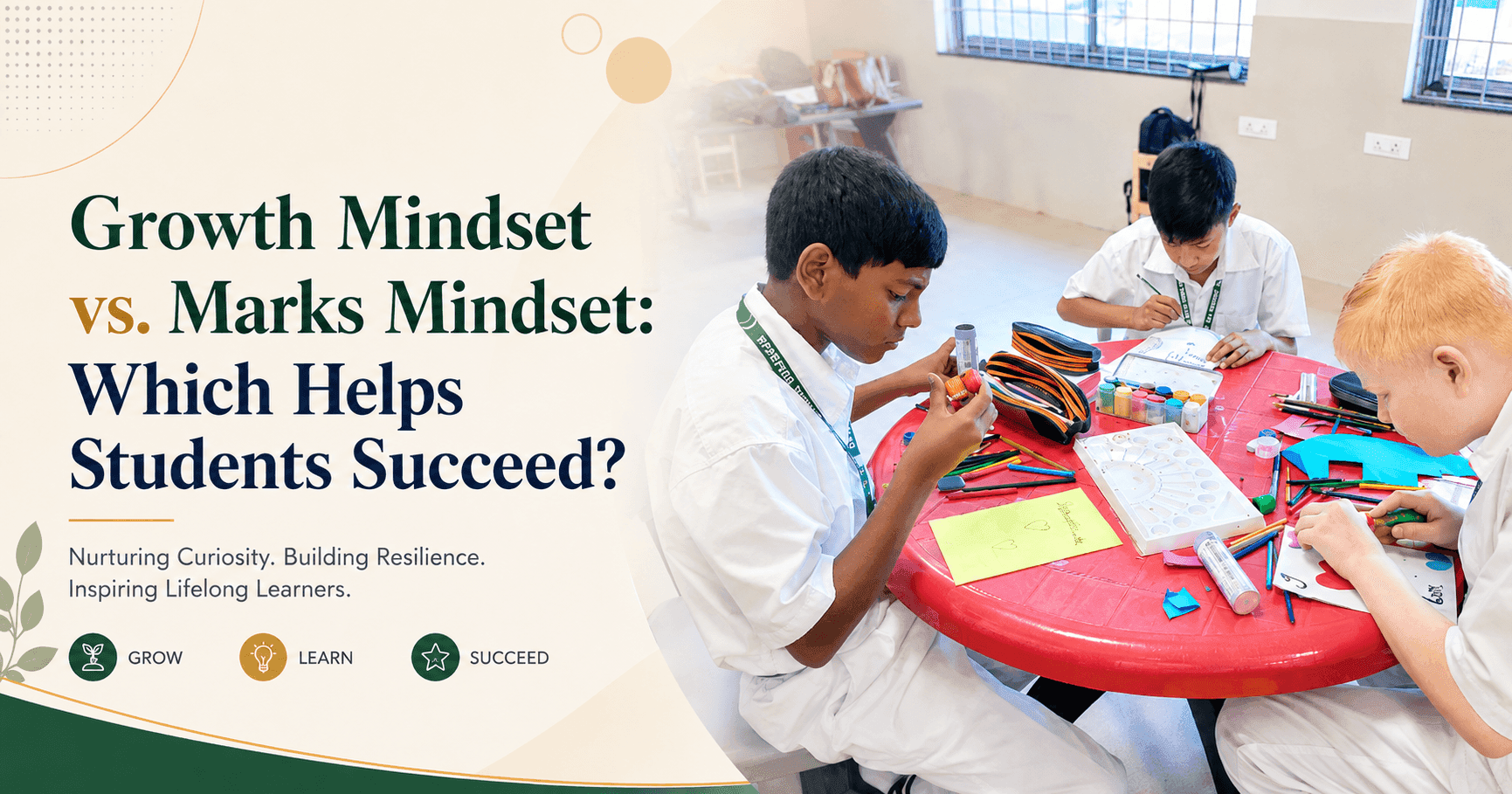
Growth Mindset vs. Marks Mindset: Which Helps Students Succeed?
Dps Deoghar Team
August 4, 2026
High marks feel like success — but do they guarantee it? Discover why a growth mindset builds the confidence, resilience and curiosity marks alone can't, and how DPS Deoghar helps students learn beyond the report card.
Report card day brings a familiar mix of excitement and anxiety to most Indian households. A single number on a page can decide, at least for that evening, whether a child feels proud or defeated. Yet marks alone rarely tell the full story of a student's ability to think, adapt and grow. This is where the debate around growth mindset vs marks mindset becomes important for parents, teachers and students alike. This article explains what each mindset means, how they affect learning and confidence, and which approach genuinely supports long-term success — without suggesting that marks do not matter. Along the way, we also look at how a student-centred learning environment can help children build both strong academics and a healthy attitude towards effort and improvement.
What Is a Growth Mindset?
A growth mindset is the belief that abilities and intelligence can be developed through effort, practice and the right strategies. Students with this mindset see mistakes as useful feedback rather than as failures, and they respond to challenges with curiosity instead of avoidance.
This concept, popularised by psychologist Carol Dweck's research, rests on a simple idea: skills are not fixed traits but qualities that improve with consistent work.
Key features of a growth mindset include:
Believing abilities can improve through effort and practice
Learning from mistakes instead of fearing them
Accepting constructive feedback openly
Developing resilience after setbacks
Viewing challenges as opportunities to learn
Classroom example: Imagine a student who scores poorly in a mathematics test on quadratic equations. A growth-minded student reviews the incorrect steps, asks the teacher for clarification, practises similar problems and improves gradually over the following weeks. The setback becomes a stepping stone rather than a full stop.
What Is a Marks Mindset?
A marks mindset defines success mainly through grades, ranks and examination scores rather than through the depth of understanding gained. Under this approach, a test score becomes the primary measure of a student's worth and ability.
This is a common and understandable mindset in a competitive academic environment, and it is not inherently harmful in moderation. However, when marks become the only measure of progress, certain patterns tend to appear:
Measuring success mainly through grades and examination scores
Comparing performance with classmates
Fear of making mistakes in front of others
Memorisation aimed at examinations rather than understanding
Pressure to achieve consistently high scores
A marks mindset is not something to be ashamed of — many disciplined, hardworking students value their scores highly. The concern arises only when marks completely overshadow curiosity, effort and emotional well-being.
Growth Mindset vs. Marks Mindset: Key Differences
The table below offers a clear, side-by-side comparison to help parents and teachers understand where the two approaches diverge.
Area | Growth Mindset | Marks Mindset |
|---|---|---|
Definition of success | Progress, effort and understanding | High scores and grades |
Response to failure | Sees it as a learning opportunity | Sees it as a setback or personal shortcoming |
Learning method | Focused on understanding concepts | Focused on memorisation for exams |
Motivation | Internal — driven by curiosity and improvement | External — driven by scores and comparison |
Classroom participation | Actively asks questions, engages with challenges | May stay quiet to avoid mistakes |
Confidence | Builds steadily through effort | Depends heavily on results |
Long-term development | Supports adaptability and lifelong learning | May not extend beyond the exam |
Examination performance | Improves gradually through consistent practice | May peak short-term but plateau over time |
Emotional well-being | Generally more stable and resilient | Can be affected by result-related stress |
Why a Growth Mindset Supports Long-Term Student Success
A growth mindset builds capabilities that extend well beyond any single exam. It shapes how students think, cope and grow throughout their academic journey.
Confidence: Students learn to trust their ability to improve, rather than tying self-worth to one result.
Resilience: Setbacks such as a low test score become recoverable rather than defining.
Critical thinking: Curiosity about "why" and "how" leads to deeper subject understanding, not just recall.
Problem-solving: Facing difficult questions builds the habit of trying multiple approaches.
Curiosity: Learning becomes enjoyable rather than a task to finish.
Independent learning: Students take ownership of revising weak areas instead of waiting to be told.
Adaptability: Changing syllabi, question patterns or subjects feel less intimidating.
Collaboration: Peer discussions and group projects are approached with openness rather than competition.
Lifelong learning: The habit of improving through effort continues well beyond school years.
For example, a student preparing a school science project who initially struggles with data collection but keeps refining the method — instead of giving up — is practising exactly these skills.
Can a Marks-Oriented Mindset Affect Students Negatively?
Yes, an excessive focus on marks can affect students negatively when it becomes the sole measure of self-worth. This does not mean every student who values marks is at risk — the concern lies specifically in an unbalanced focus on scores alone.
Possible effects of excessive marks pressure include:
Fear of failure before attempting difficult tasks
Academic anxiety around tests and results
Reduced creativity, as students avoid risk-taking
Unhealthy comparison with classmates or siblings
Loss of motivation when results do not meet expectations
Avoiding subjects perceived as "difficult" or "low-scoring"
Dependence on external validation from marks or rankings
Memorising content without genuine understanding
These are common patterns observed in academic settings, not clinical conditions, and every child experiences them differently.
Are Marks Still Important?
Yes, marks are still important because they help measure academic progress, highlight areas needing improvement and support access to future academic opportunities. Marks should be seen as one form of feedback, not as a complete definition of a student's intelligence or potential.
Marks continue to serve useful purposes:
Helping measure academic progress over time
Identifying specific areas that require improvement
Supporting admissions and academic opportunities
Encouraging discipline, planning and goal-setting
The healthiest approach treats a mark as information — a signal of what to revise next — rather than a verdict on a child's abilities.
Growth Mindset and Academic Performance
Yes, a growth mindset can improve exam results because it encourages consistent practice, better use of feedback and a deeper understanding of concepts rather than short-term memorisation.
This connection works through several practical habits:
Consistent practice: Regular revision builds retention better than last-minute cramming.
Better response to feedback: Corrections from teachers are used to improve, not avoided out of embarrassment.
Stronger subject understanding: Concepts learned with curiosity are remembered longer.
Willingness to ask questions: Doubts get cleared early instead of piling up before exams.
Learning from incorrect answers: Mistakes in practice tests reveal exactly what to revise.
Setting realistic improvement goals: Small, achievable targets (like improving one subject by ten marks) keep motivation steady.
How Teachers Can Build a Growth Mindset in Students
Teachers play a central role in shaping how students relate to effort, mistakes and achievement in the classroom.
Praise effort, strategy and improvement, not only the final score
Encourage students to ask questions without hesitation
Use mistakes as learning opportunities during lessons
Give constructive and specific feedback rather than vague comments
Allow time for reflection after tests and assessments
Set achievable, incremental learning goals for each student
Encourage active classroom participation from all students
Celebrate consistent progress, not only top scores
How Parents Can Encourage Learning Beyond Marks
Parents shape a child's relationship with learning long before — and long after — any report card arrives.
Ask children what they learned that day, not only what marks they scored
Avoid comparisons with siblings, cousins or classmates
Praise consistency and visible improvement over time
Create a safe environment where mistakes can be discussed openly
Encourage reading, exploration and hobbies outside the syllabus
Help children set realistic, personal goals rather than external benchmarks
Avoid connecting a child's self-worth directly to examination scores
Practical Growth Mindset Activities for Students
These simple activities can be used at home or in school to build growth-mindset habits over time.
Learning reflection journal – Students note down one new thing they learned each day.
"What I learned from my mistake" activity – After a test, students write what went wrong and how to fix it.
Weekly improvement goals – Small, specific targets, such as improving handwriting speed or a particular topic.
Progress tracker – A simple chart showing improvement over weeks, not just final scores.
Positive self-talk exercise – Replacing "I can't do this" with "I can't do this yet."
Challenge-of-the-week activity – One slightly difficult problem attempted without fear of getting it wrong.
Peer learning and feedback – Students explain concepts to classmates and receive friendly feedback.
Reattempting difficult questions – Revisiting unresolved problems after some days, with fresh understanding.
How Schools Can Balance Academic Results and Holistic Development
A good school supports academic excellence while also nurturing a child's broader growth as a person. This balance is where genuine long-term development happens.
Schools can support this through:
Sports and physical wellness programmes
Arts and creative expression opportunities
Communication and public speaking skills
Leadership roles in school activities
Creativity through open-ended projects
Emotional well-being support systems
Experiential and activity-based learning
Critical thinking exercises across subjects
Values and life-skills education
Delhi Public School Deoghar aims to combine strong academics with these wider areas of growth, recognising that examinations are one part of a student's overall development rather than the whole of it. Programmes involving academic and co-curricular learning help students build confidence in areas beyond the classroom as well.
Which Mindset Ultimately Helps Students Succeed?
A growth mindset generally supports long-term student success more effectively than a marks-only approach, because it teaches students to improve, adapt and learn from setbacks throughout their lives. This does not mean marks should be ignored — it means academic achievement is best pursued through understanding, effort, consistency and continuous improvement, with marks as one healthy indicator among many.
The strongest students are usually not those who fear a low score, but those who know exactly what to do next after one.
Conclusion
Marks and mindset are not opposing forces — they work best together. A growth mindset gives students the resilience, curiosity and confidence to keep improving, while marks continue to serve as a useful, honest measure of progress along the way. Neither element should be dismissed in favour of the other.
For parents and teachers, the goal is simple: help children see every test, mistake and report card as part of a longer learning journey, not as a final judgment. At Delhi Public School Deoghar, this balance between academic achievement and personal growth remains at the heart of how students are supported to learn, improve and thrive — both in the classroom and beyond. Families exploring admissions at Delhi Public School Deoghar can learn more about how this approach shapes everyday school life.
FAQs
A growth mindset is the belief that abilities, skills and intelligence can be developed through consistent effort, practice and learning from mistakes. Students with this mindset see challenges as opportunities to improve rather than as threats to avoid, which supports steady academic and personal growth over time.
A marks-oriented mindset defines success mainly through examination scores, grades and rankings. While discipline and goal-setting are useful outcomes of this approach, an excessive focus on marks alone can sometimes reduce curiosity, increase comparison with peers and add unnecessary academic pressure.
A growth mindset is generally more supportive of long-term development because it builds resilience, confidence and adaptability. However, marks remain a useful indicator of academic progress, so the healthiest approach combines both — pursuing good results through genuine effort and understanding.
Yes, a growth mindset can improve academic performance because it encourages consistent practice, better use of teacher feedback and deeper conceptual understanding. Students become more willing to ask questions and revisit mistakes, which strengthens learning ahead of examinations.
Excessive marks pressure can lead to fear of failure, academic anxiety, reduced creativity and unhealthy comparison with classmates. It may also encourage memorisation over genuine understanding. These effects vary from student to student and are not the same for every child.
Teachers can build a growth mindset by praising effort and strategy rather than only results, encouraging questions, treating mistakes as learning opportunities, giving specific feedback and celebrating steady progress alongside strong scores.
Parents play a vital role by asking children what they learned rather than only their marks, avoiding comparisons with others, praising improvement, and creating a safe space to discuss mistakes without fear of judgment or punishment.
Get in Touch
Still have questions? Fill out the form below and our team will get back to you shortly.